
Part 1 of 2
When Bronze Gets It Wrong
We trust monuments. That may be history’s simplest and most dangerous assumption. When words are cast into bronze, mounted permanently on a concrete base, and placed before the public as a statement of remembrance, few people ever stop to ask a simple question.
But what if the monument is wrong? For decades, a memorial plaque in Kanchanaburi, Thailand stood as an unquestioned statement of historical fact. Its inscription declared that 356 American prisoners of war died during construction of the Thai–Burma Railway construction during World War II.
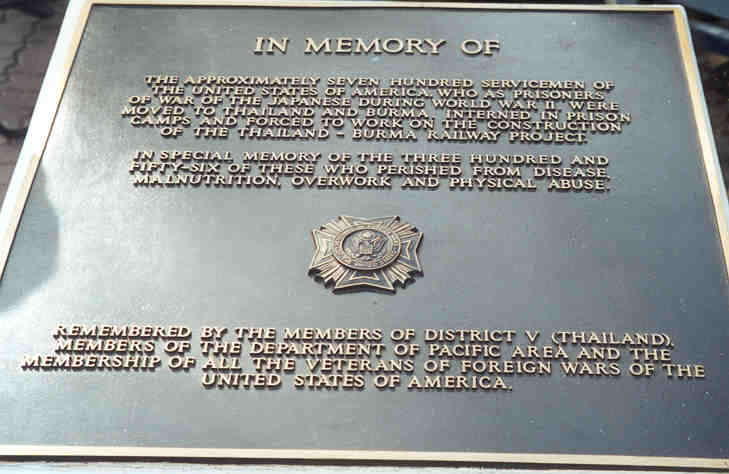
Visitors accepted the number. Tour guides repeated it. Writers incorporated it into historical summaries. Researchers cited it without challenge.
The bronze spoke with authority. And because bronze suggests permanence, permanence became mistaken for truth. Yet history does not become accurate simply because it is memorialized. Years later, a painstaking reconstruction of American prisoner records began. Military transport rosters. Camp records. Death certificates. Hospital logs. Burial registers. Postwar recovery documents.
Individual names were traced one by one. And a profoundly uncomfortable conclusion emerged. The accepted number was wrong. Not slightly wrong. Fundamentally wrong.
The actual number of Americans who died while assigned to the railway system proved dramatically lower than the figure publicly memorialized for decades. But the real question is not who made the original mistake. Mistakes happen. The more troubling question is far larger. How did nobody verify the number?
The answer is deceptively simple. Because once history is cast in bronze, people stop asking questions. Memorials carry authority. They imply that someone, somewhere, must already have done the work. Surely the records were checked. Surely historians confirmed the arithmetic. Surely the inscription had been verified before becoming permanent. And so nobody else checks. The number is repeated. Then repeated again. Over time repetition itself becomes evidence.
The original source disappears. The uncertainty vanishes. The error survives simply because each generation assumes the previous generation already verified it. This may be one of history’s greatest vulnerabilities. Not deliberate falsification. Not forgotten memory. But unexamined trust.
Across the world, monuments shape public understanding of the past. They teach visitors what happened. They define collective memory. But what happens when the monument itself is wrong? One incorrect number on one bronze plaque in Thailand forces an uncomfortable realization. History is not always wrong because someone intended deception.
Sometimes history is wrong simply because nobody thought to question what had already been accepted. The bronze did not create truth. It created confidence. And confidence, left unchallenged long enough, can preserve error for generations. Perhaps history’s greatest weakness is not forgetting. Perhaps its greatest weakness is believing too readily that the past has already been understood.
====================================
Part 2 of 2
When Estimates Become History
One of the most widely repeated numerical claims in the history of the Thai–Burma Railway construction during World War II concerns the vast Asian labor force known collectively as the romusha.
Open almost any modern history of the railway and the numbers appear with remarkable consistency.
Approximately two hundred thousand Asian laborers were employed.
Perhaps ninety thousand or even one hundred thousand died.
The figures have been repeated so frequently that they now carry the weight of established historical fact.
And among researchers familiar with Thai–Burma Railway scholarship, many know that much of this numerical framework traces back to the work of historian Rod Beattie, whose contributions to preserving and documenting railway history have been both substantial and widely respected.
But history sometimes forces us to confront uncomfortable methodological questions. Not because historians act irresponsibly. But because figures, once repeated long enough, can gradually transform into unquestioned truth. The fundamental problem is not that numerical estimates were proposed. Estimation is often necessary in historical research, particularly when documentation is fragmentary or incomplete.
The deeper question is this. How were such numbers originally derived?
Unlike Allied prisoners of war, whose military records, transport manifests, camp registers, death certificates, and postwar recovery documentation allow historians to reconstruct relatively reliable casualty figures, the Asian labor force presents an entirely different challenge. Many laborers were recruited locally without formal registration.
Others were transported from Burma, Malaya, Thailand, Singapore and Java under chaotic wartime conditions. Records were inconsistent. Japanese documentation was incomplete. Their deaths frequently went unrecorded. Entire labor groups disappeared without leaving behind meaningful administrative records. In some cases, there may never have been records at all.
And yet despite these extraordinary documentary limitations, modern historical writing frequently presents romusha casualty estimates with striking numerical confidence. Two hundred thousand workers. Ninety thousand deaths. One hundred thousand deaths. Sometimes higher. Sometimes lower. But almost always presented with a degree of certainty that implies evidentiary precision.
This creates a serious historiographical problem. If the underlying documentary evidence cannot be independently reconstructed, how should later historians treat such estimates? As plausible approximations? As provisional working figures? Or as established historical fact?
Over time a subtle transformation occurs. An estimate appears in one respected work. Later researchers repeat it. Museums adopt the number. Documentaries cite it. Tour guides repeat it to visitors. Students encounter it in textbooks. Eventually the estimate ceases to function as approximation. It becomes accepted truth.
And gradually something dangerous happens. The original uncertainty disappears. The number acquires authority simply through repetition. This is not a criticism of one historian. It is a warning about how historical memory functions. Every historian works within limits imposed by available evidence.
The challenge emerges when later generations forget those limitations. The number survives. The uncertainty vanishes. And the estimate hardens into fact.
Perhaps the deeper lesson extends beyond the Thai–Burma Railway itself. History often presents itself as certainty. But certainty is sometimes an illusion. Some facts are documented. Some facts are reconstructed. Some facts are estimated. And some estimates become so deeply repeated that nobody remembers they began as approximation.
The danger is not that historians estimate. The danger begins when later generations stop asking how the estimate was produced. History repeated often enough becomes truth. Even when the underlying arithmetic remains forever uncertain.
And perhaps nowhere is that danger more visible than in the forgotten dead of the Thai–Burma Railway. The stories history forgot. And sometimes…The numbers history accepted too easily.
=============================