
Railway Temples: The Religious Landscape of the Thai–Burma Railway
The withdrawal of direct Thai governmental support for the Thai–Burma Railway during the early stages of construction should not be interpreted as the withdrawal of Thailand itself from the railway project. The distinction between the Thai state and Thai society is important. While the government could distance itself from direct participation in the Japanese undertaking, the railway continued to be constructed through an established Thai landscape in which Buddhist temples were among the most prominent social, cultural, and geographical institutions.
The temples could not withdraw. They were already situated along the routes, settlements, rivers, and communities through which the railway was being constructed. As the railway advanced westward from Nong Pladuk toward the Burmese frontier, these institutions were encountered repeatedly. Some were incorporated directly into the railway’s functional system; others became associated with camps or resources used by railway personnel and prisoners; some were physically affected by construction; others became involved in the treatment and cremation of the dead. After the war, several became repositories for the physical and cultural memory of the railway.
The result was an inadvertent religious participation in the railway project. This participation should not be confused with endorsement or collaboration. In some instances, the evidence suggests direct appropriation of existing facilities; in others, the connection was simply a consequence of geography. The significance lies in the fact that the railway was imposed upon an existing Buddhist landscape and consequently became intertwined with institutions that had not been created for it and were not necessarily seeking any role in it.
The sequence is best understood by following the railway from east to west.
1. Wat Khok Mo — Nong Pladuk
The sequence begins at Wat Khok Mo near Nong Pladuk, the starting point of the Thai section of the railway.
Wat Khok Mo occupied an established Buddhist position within the one and half kilometers from Nong Pladuk as the enormous movement of prisoners and railway laborers began. Local historical accounts associate the temple with the influx of personnel during the initial construction period and describe it as an overflow transit facility when the principal facility became overwhelmed.
The significance of Wat Khok Mo is therefore primarily logistical and geographical. The railway did not begin in an empty landscape. Its eastern starting point was embedded within an existing Thai community, and the extraordinary concentration of prisoners and laborers placed pressure upon institutions that already occupied that landscape.
Wat Khok Mo represents the first degree of religious incorporation: an established temple drawn into the railway’s initial system of movement and accommodation.
2. Wat Don Tum — Ban Pong
Proceeding westward from Nong Pladuk, the next major temple is Wat Don Tum at Ban Pong.
Here the relationship with the railway becomes considerably more direct. The temple grounds became part of the Ban Pong wartime camp complex, incorporating both military and prisoner facilities. The temple was therefore not simply a landmark beside the railway. It became part of the machinery through which prisoners and workers were assembled and moved toward the construction zones.
Wat Don Tum is consequently one of the most important examples in the entire sequence because it represents direct operational incorporation of a Buddhist institution into the railway system. It was also at the center of the DEC 1942 conflict that became known as the Ban Pong Incident and grew into a confrontation between the Thai and Japanese governments effectively ending the Thai participation in the project.
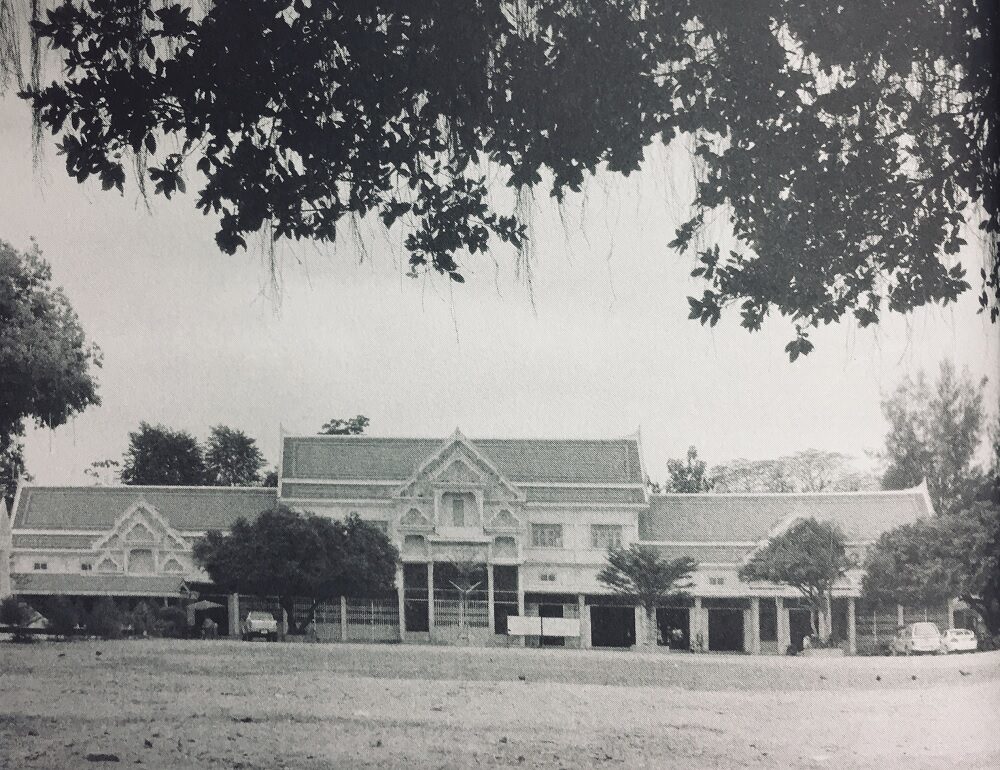
The distinction from governmental involvement is important. There is no implication that the Thai religious institution independently supported the Japanese railway project. Rather, the Japanese organization encountered an established temple at a strategically useful location and incorporated its environment into the requirements of the railway.
3. Wat Tham Khao Pun — Chungkai
The railway’s westward progression brought it into the Chungkai area, one of the principal hospital and prisoner camp complexes.
Nearby Wat Tham Khao Pun provides a particularly direct physical demonstration of the railway’s intrusion into the religious landscape. Railway construction required prisoners to cut through the rocky terrain associated with the temple, leaving surviving evidence of the engineering works.
Here the relationship is no longer simply one of proximity. The requirements of railway construction physically modified a landscape associated with an established Buddhist site.
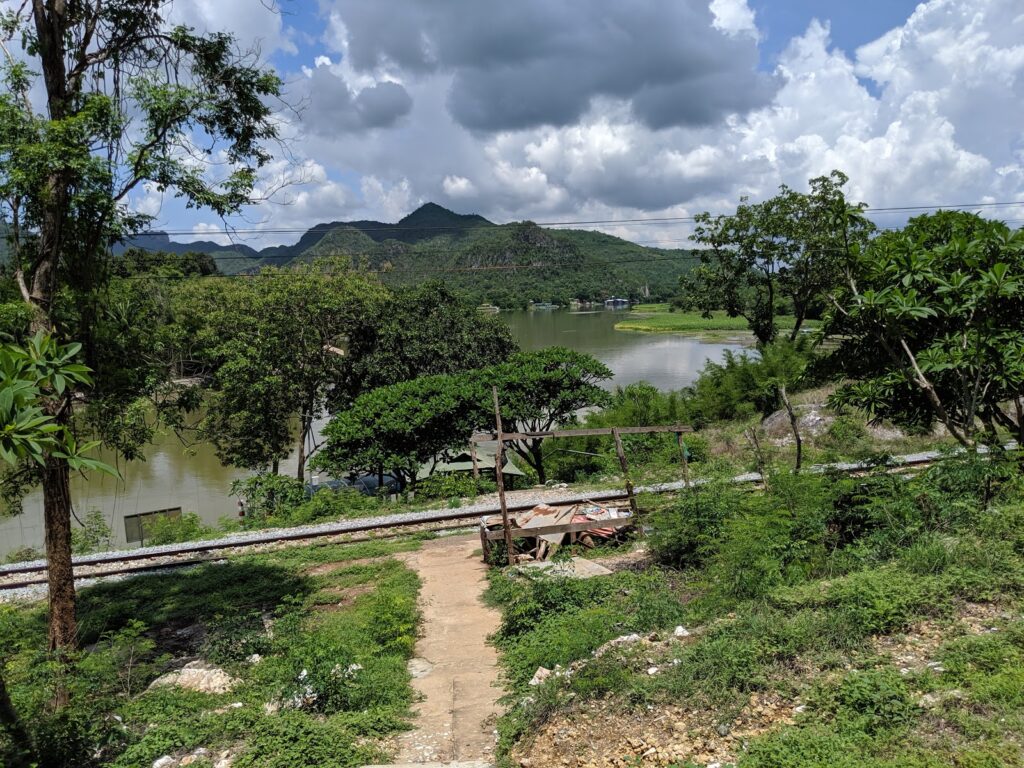
The distinction between Wat Don Tum and Wat Tham Khao Pun is useful. At Ban Pong, the temple was incorporated into the functional system of the railway. At Khao Pun, the railway altered the physical religious landscape in order to achieve its engineering objectives.
Both resulted from the same fundamental circumstance: an externally imposed railway project operating within an existing Thai landscape.
4. Wat Wang Khanai Thayikaram — Tha Muang
Continuing westward, the railway entered the Tha Muang area, where Wat Wang Khanai Thayikaram provides a more peripheral example.
The temple was already associated with natural springs, and post-construction, the surrounding area became part of the railway’s camp environment. Accounts have associated prisoners with bathing at the springs. The modern bathing complex, however, is substantially later and should not be projected backward onto the wartime landscape. What existed during the railway period was the natural spring environment.
Wat Wang Khanai therefore occupies a different position in the sequence from Wat Don Tum. It was not a principal railway camp. Its relevance arose from its geographical position and the natural resource associated with the temple.
It represents a peripheral interaction between the railway system and an existing religious landscape: the temple’s location and resources brought it into the orbit of the railway without transforming it into a central railway facility.
5. Wat Thewa Sangkharam — Kanchanaburi
Within the walled city of Kanchanaburi, Wat Thewa Sangkharam acquired an important but more peripheral connection through the cremation of railway dead.
Its role illustrates why the concept of “railway temples” should not be limited to temples that housed prisoners or railway personnel. The railway generated a mortality on a scale that necessarily affected the surrounding Thai community.
The temple’s function was therefore not operational railway support in the sense of Wat Don Tum. Rather, it became involved in one of the consequences of the project: the cremation of those who died in the post-construction period.
6. Wat Thaworn Wararam — Kanchanaburi
Wat Thaworn Wararam, also known as Wat Yuan[1], became associated with the remains and subsequent commemoration of Asian laborers who died during construction.
Its importance therefore lies not in serving as a principal railway installation but in the role played by the Buddhist community in dealing with the enormous mortality generated by the project.
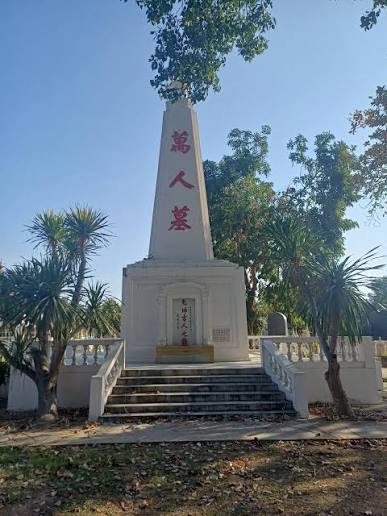
The distinction is important. The railway created consequences that extended beyond its immediate camps and engineering works. The dead had to be dealt with, and Buddhist temples formed part of the established social and religious structure through which death was managed and subsequently remembered. Wat Thaworn Wararam therefore represents the religious incorporation of the railway’s human consequences.
7. Tham Krasae — Wang Pho
The railway then continued westward toward Wang Pho, where the relationship between the railway and the religious landscape took an especially distinctive form.
Post-wat at Tham Krasae, adjacent to the Wang Pho viaduct, the wartime railway landscape was eventually transformed into a Buddhist shrine. The railway was constructed along the limestone cliff above the Khwae Noi River, and the approximately 400-metre trestle was built during March and April 1943.
The cave should not be treated as though it were simply another pre-existing temple appropriated by the railway. During the war it formed part of the railway worksite and was used by prisoners as a shelter or resting place; other accounts associate it with construction materials and protection from bombing.
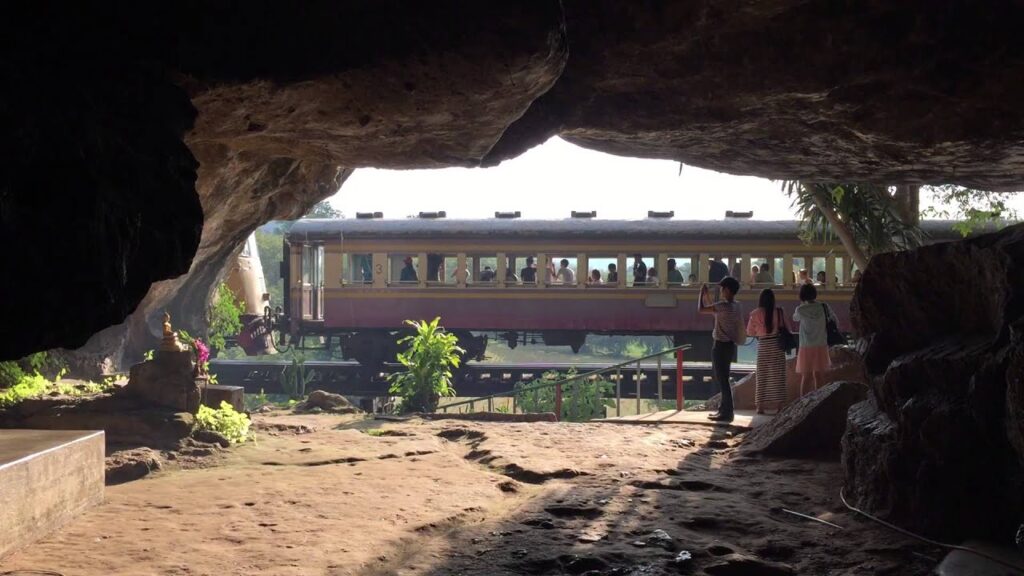
Its religious transformation occurred subsequently.
Today the cave contains the Buddha image known as Luang Pho Tham Krasae and functions as a Buddhist shrine.
Tham Krasae therefore represents a different historical process from Wat Don Tum. At Ban Pong, an existing religious institution was incorporated into the railway system. At Krasae, a wartime railway site subsequently became incorporated into the religious landscape.
The sequence is therefore: natural cave → wartime railway worksite → prisoner shelter → postwar Buddhist shrine.
8. Wat Prang Kasi — Prang Kasi (approx. Kilo 210)
Much farther into the western railway corridor lies Wat Prang Kasi. By this stage, the railway had entered a substantially more remote environment. Prang Kasi itself was an important railway logistical area, including railway-maintenance and supply functions. Wat Prang Kasi survived within that transformed landscape and subsequently developed a museum function, preserving historical objects from the local area.
The evidence here requires a more restrained characterization than at Wat Don Tum. The surrounding Prang Kasi railway complex is well established, but the temple should not be described as though it were itself a principal railway installation without further evidence.
Its significance is instead that of a religious institution preserving local historical material within a major wartime railway landscape.
9. Wat Phu ThaKian — Tha Khanun, Thong Pha Phum
Farther west, at Wat Phu Thakian (near Kilo 222), the relationship becomes intrusive once again. The temple was already an established religious institution by 1930. The area immediately behind the temple became the site of Phu Thakian railway station and a Japanese command and camp complex. Historical research based upon documentary evidence and interviews has identified the station, camp, and railway embankment in directly behind the temple.
Most importantly, the temple has preserved the railway landscape itself. The surviving embankment has been conserved, rails have been laid along the old alignment as an interpretive reconstruction, and a walking path permits visitors to follow the former railway. The temple has therefore moved beyond merely being a surviving landmark of the railway period and has become a custodian and interpreter of railway heritage.
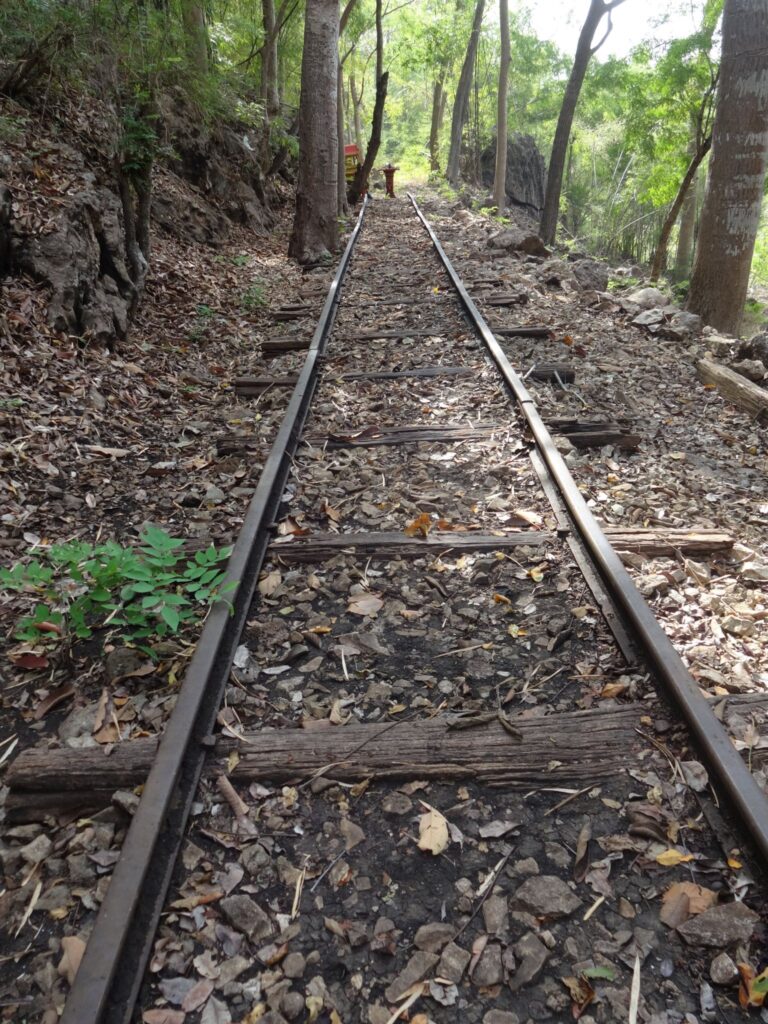
Wat Tha Khanun represents the full historical cycle: prewar temple → wartime railway station and military camp → abandoned railway → preservation of railway remains → religious custodianship of railway memory.
This makes the temple particularly significant to a Thai perspective. The railway was originally imposed upon its landscape; decades later, the surviving Thai religious institution became one of the agencies preserving evidence[2] of what that railway had left behind.
10. The western railway corridor: Taimonta, Konkoita, Ni Thea and Songkurai
Beyond Tha Khanun, the railway continued into the increasingly remote western sector toward the Thai–Burma frontier. The principal railway camps included Taimonta, Konkoita, Ni Thea (aka known as Nike), and Songkurai, and prisoners were moved through a succession of camps as the railway advanced toward the Burmese section.
This portion of the sequence is significant precisely because the physical evidence becomes increasingly fragmentary. Much of the former railway landscape has disappeared, been abandoned, or been submerged beneath the Vajiralongkorn Reservoir. The loss of these physical sites makes the surviving religious landscape increasingly important as a source of local historical continuity.
This western sector therefore illustrates a reversal of the earlier relationship. During construction, the railway penetrated the existing landscape. After its abandonment, the railway infrastructure largely disappeared while the communities and religious institutions that predated it remained.
11. Sangkhlaburi and the Three Pagodas frontier
The sequence ultimately reaches the Sangkhlaburi region and the western frontier at the Three Pagodas Pass.
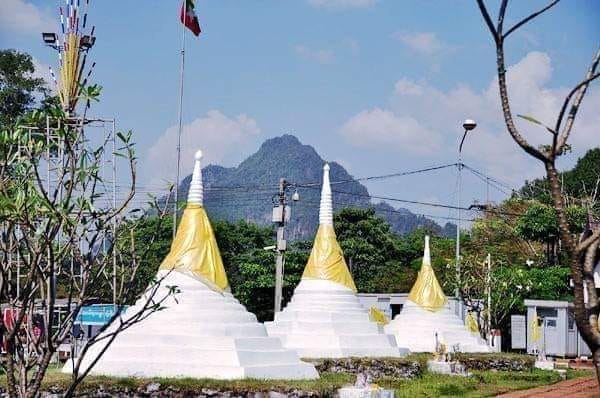
Here the relationship must again be stated carefully. The railway continued beyond the Thai settlements toward the frontier and into Burma, while much of the original railway landscape in this region has subsequently disappeared. The modern religious landscape of Sangkhlaburi should therefore not be presented wholesale as a collection of wartime railway installations.
Its importance is instead geographical and cultural. The temples and Buddhist communities of the western region represent the enduring religious landscape within which the final Thai section of the railway existed.
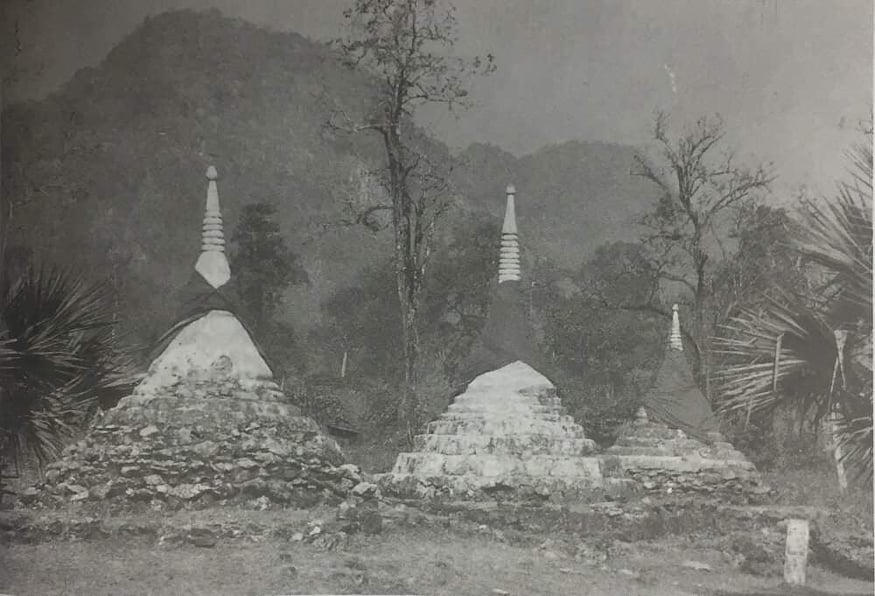
At the frontier, the historical railway and the Buddhist landscape converge geographically even where a direct wartime institutional relationship cannot be demonstrated. The railway reached the edge of the Thai religious and settlement landscape before crossing into Burma.
The significance of the sequence
Viewed sequentially, these temples reveal a progression in the relationship between the railway and Thai Buddhism.
At Wat Ko Mo, an established temple lay within the railway’s initial logistical environment.
At Wat Don Tum, the religious institution was incorporated directly into the prisoner and military system.
At Wat Wang Khanai, the relationship became more peripheral, with the temple and its natural resources situated within the railway’s camp environment.
At Wat Thaworn Wararam and the adjacent Wat Thewa Sangkharam, the temples became involved in dealing with the consequences of railway mortality.
At Wat Tham Khao Pun, railway construction physically altered the religious landscape.
At Tham Krasae, a wartime railway site subsequently became a Buddhist shrine.
At Wat Prang Kasi, a surviving religious institution remained within an important former railway and logistics zone and preserved local historical material.
At Wat Tha Khanun, a pre-existing temple became embedded in a major western railway complex and later assumed a role in preserving the physical remains of the railway.
Beyond Tha Khanun, toward Taimonta, Konkoita, Ni Thea, Songkurai, and Sangkhlaburi, the railway entered a landscape in which many of its own physical traces have disappeared while the religious and cultural landscape has endured.
This sequence provides the necessary counterpoint to the discussion of Thai governmental non-involvement.
The withdrawal of the Thai government from direct participation did not mean that the railway operated outside Thai society. It operated through Thailand. It passed through established communities and through a landscape already structured in part by Buddhist institutions.
The temples did not constitute a unified participant in the railway project. Their roles ranged from central to peripheral, from operational to commemorative, and from wartime involvement to postwar preservation. Nor should those roles be retrospectively characterized as voluntary cooperation. In many cases, their involvement arose simply because the institutions were already present where the railway needed to go.
This distinction is central to the Thai perspective. The Thai government could withdraw its direct support. The temples could not withdraw from their geographical locations.
Consequently, the railway progressively incorporated elements of the Thai religious landscape into its own physical and social environment. Wat Don Tum became part of the railway’s prisoner system; Wat Tham Khao Pun was physically altered by its construction; Kanchanaburi temples became involved with the dead; Krasae became a postwar Buddhist interpretation of a railway site; and Wat Tha Khanun ultimately became a custodian of surviving railway remains.
The railway therefore left behind more than bridges, embankments, cemeteries, and abandoned camps. It left a religious geography. That geography provides an important counterpoint to the absence of direct Thai governmental participation. The state could disengage from the project, but the institutions embedded in the landscape remained exposed to it. Through circumstance, geography, necessity, and in some instances coercion, Thai temples became part of the railway story.
Their importance lies not in suggesting Thai religious endorsement of the enterprise, but in demonstrating how deeply the railway penetrated the society through which it was constructed.
The sequence from Wat Khok Mo at Nong Pladuk to the western frontier at Sangkhlaburi therefore provides a distinctly Thai perspective on the railway: an externally imposed wartime project encountered an established Buddhist landscape, incorporated portions of it into its operations, altered other portions physically, generated consequences that local religious institutions were required to address, and ultimately left a legacy that some of those same institutions would preserve.
The Three Pagodas frontier
At the opposite end of the Burmese section, the railway approached the Three Pagodas Pass, the historic frontier between Thailand and Burma. The railway crossed the border in the vicinity of the pass before continuing toward Thanbyuzayat.
While not technically a temple, the Three Pagodas themselves are an important Buddhist and cultural landmark, but the available evidence does not establish that they functioned as a railway camp, railway facility, cremation site, or other operational component of the railway.
That distinction should be maintained. Their significance is geographical rather than operational. The railway entered a landscape that already possessed an established religious identity. The presence of the pagodas at the frontier therefore provides a useful terminus for understanding the cultural landscape into which the railway was inserted, even though the pagodas should not be characterized as railway installations.
Although not technically part of the Thai perspective, it seems appropriate to continue to look at the Buddhist involvement of the Railway in Burma:
The Burmese Religious Landscape
The relationship between the Thai–Burma Railway and the Buddhist religious landscape changed as the railway crossed from Thailand into Burma. On the Thai side, the evidence demonstrates several instances in which pre-existing temples were incorporated, directly or indirectly, into the wartime railway system. In Burma, the available evidence is less extensive and the relationship appears to have been more often expressed through the postwar religious preservation and reinterpretation of railway remains.
This distinction is important. The absence of Burmese temples functioning as railway camps or facilities should not be interpreted as evidence that the railway operated outside Burmese society. The Burmese section traversed a comparatively remote landscape, and much of the physical railway and its associated settlements subsequently disappeared. The surviving evidence instead reveals instances in which Buddhist communities later encountered the abandoned railway landscape and incorporated portions of it into religious memory.
The strongest examples occur at Anankwin, Wae Ton Chaung, and Thanbyuzayat, with the sequence extending westward from the Three Pagodas region to the Burmese terminus.
Anankwin: a railway structure becomes a Buddhist shrine
At approximately the 45-kilometre point of the Burmese section[3], Anankwin was an important railway location. The 2015 field survey by Peter Winstanley and John Brereton records the site as the location of No. 1 Mobile Force and documents railway infrastructure including passing loops, jungle-protection sidings, a turning triangle, bridge structures, locomotive water-supply foundations, and surviving Japanese building foundations. Anankwin is particularly significant because a surviving railway structure subsequently acquired a Buddhist function.
A concrete railway bridge pier, approximately three meters high, survives in the forest. A small stupa or Buddhist shrine has been constructed on its summit. According to the account of a subsequent field visit, a monk advised villagers approximately forty years ago to construct the stupa and specifically instructed them not to destroy the surviving structure.
The significance of this transformation is considerable. The railway pier was originally an element of Japanese military engineering. Its subsequent preservation beneath a Buddhist shrine represents a distinctly different relationship between the railway and religion from that found at Wat Don Tum in Thailand.
At Ban Pong, an existing Buddhist institution was drawn into the wartime railway system. At Anankwin, a surviving railway structure was subsequently drawn into the Buddhist landscape.
The sequence is therefore: wartime railway infrastructure → abandoned railway structure → Buddhist intervention → sacred preservation of the railway remains.
This may be one of the clearest Burmese examples of the transformation of railway material into religious memory.
Wae Ton Chaung: commemoration through a Buddhist structure
A second example occurs at Wae Ton Chaung Village, within the Thanbyuzayat area.
A Japanese-built pagoda was constructed there to commemorate people who died during the railway project. The pagoda was identified as part of the historical material associated with the Thanbyuzayat Death Railway Museum when the museum complex opened.
The character of this site differs from Anankwin. There a shrine incorporates an actual surviving component of railway infrastructure. The Wae Ton Chaung pagoda represents the memorialization of railway deaths through a Buddhist structure.
The distinction is nevertheless less important than the underlying process. The railway generated enormous mortality within a landscape inhabited by Burmese communities. The subsequent religious commemoration of those deaths became part of the local landscape.
The pagoda therefore provides evidence that the railway was not remembered solely through military cemeteries, museums, or European and Allied memorial traditions. It also entered the religious landscape of Burma.
Thanbyuzayat: the railway terminus and Buddhist memory
At Thanbyuzayat, the western terminus of the railway, the relationship between the railway and the Burmese landscape becomes especially concentrated. This was the principal Burmese railway base and the point at which the new railway connected with the existing Burmese railway system. The town subsequently became the location of the Thanbyuzayat War Cemetery and the Death Railway Museum.
The religious dimension is less direct than at Anankwin or Wae Ton Chaung, but evidence indicates that railway material itself entered Buddhist remembrance. A railway sleeper from Thanbyuzayat was subsequently placed in a shrine-like setting and used as an object of Buddhist remembrance for those who died during construction.
This is an important conceptual development. The railway was constructed as a military transportation system, but portions of its physical remains subsequently acquired meanings that had nothing to do with transportation. The sleeper ceased to be merely a component of railway infrastructure and became an object associated with remembrance.
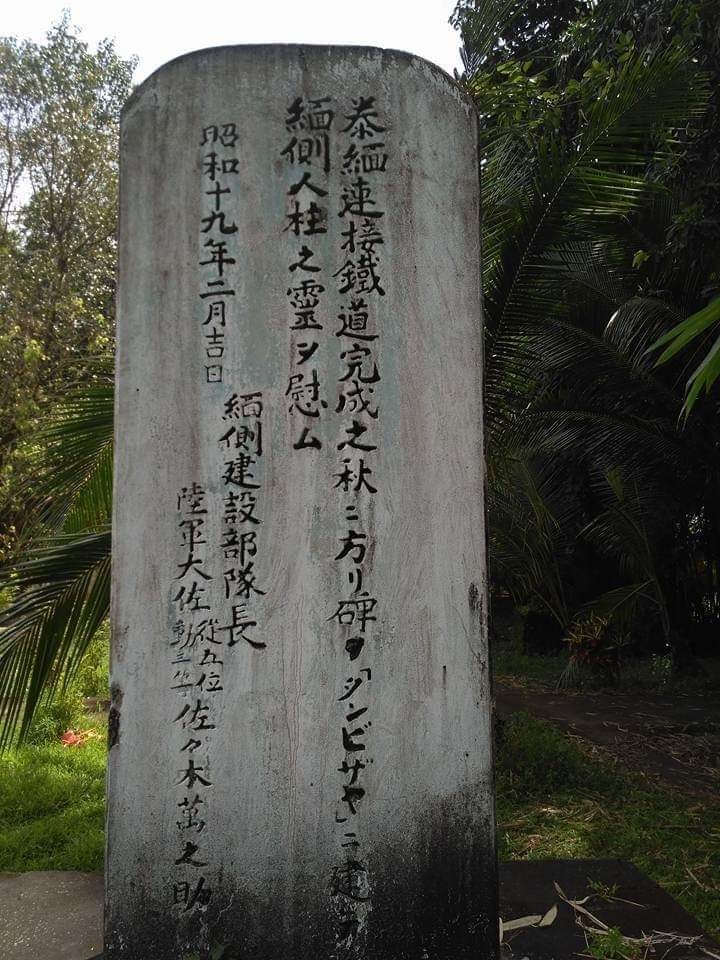
Thanbyuzayat therefore provides a useful endpoint for the Burmese religious sequence: the railway terminus became a place in which railway history, death, local memory, and Buddhist commemoration converged.
A different Burmese pattern
The Burmese evidence consequently suggests a pattern that differs from that identified in Thailand.
On the Thai side, the sequence includes numerous examples of existing temples becoming involved during railway construction. All available research identifies these contrasting forms of wartime and postwar religious involvement along the Thai route.
On the Burmese side, the evidence points more strongly toward religious incorporation after the railway had ceased to function.
At Anankwin, a surviving railway bridge pier became the foundation of a Buddhist shrine.
At Wae Ton Chaung, a pagoda commemorated those who died during railway construction.
At Thanbyuzayat, railway material became associated with Buddhist remembrance.
These examples suggest that the Burmese religious landscape did not necessarily become a major functional component of the railway. Instead, it became an important medium through which the railway’s physical remains and human consequences could subsequently be remembered.
This distinction may reflect geography as much as institutional difference. The Burmese section extended through difficult and relatively remote terrain. The railway’s camps were often separated from established population centers, and access to many of the former railway sites remains difficult even today. A 2015 field survey noted that many points of interest could only be reached on foot through jungle terrain and that the surviving railway landscape was consequently difficult to access.
The physical disappearance of much of the railway has therefore made surviving religious associations particularly significant.
A religious landscape that outlived the railway
The Burmese experience reinforces a broader point developed from the Thai evidence. The railway itself was temporary. The institutions and communities through which it passed were not.
The Japanese military constructed the railway as an instrument of war. Once the war ended, much of the railway was abandoned, dismantled, destroyed, or reclaimed by the jungle. Yet the surrounding communities remained, and the surviving physical traces could acquire new meanings. These transformations demonstrate that the historical significance of the railway did not end when the trains stopped running. Its physical remnants entered the cultural landscapes of the communities that inherited them.
The Burmese evidence therefore provides a useful counterpart to the Thai experience. In Thailand, Buddhist institutions were sometimes drawn into the railway during construction. In Burma, the surviving evidence more often demonstrates that Buddhist institutions and communities subsequently absorbed the railway into local memory.
The distinction should not be overstated. The Burmese documentary record remains incomplete, additional field research may identify temples or monasteries that played more direct roles during construction. At present, however, the evidence does not justify constructing an extensive list of Burmese “railway temples” comparable to the Thai sequence.
What can be stated with greater confidence is that the railway entered a pre-existing Burmese cultural landscape and that, after the railway disappeared, elements of that landscape became custodians of its memory.
The most revealing example may be Anankwin. A structure created by the Japanese military to carry a railway eventually became the base for a Buddhist shrine, preserved because a monk recognized that the physical remains should not be destroyed. The transformation is emblematic: military infrastructure → abandoned railway relic → Buddhist preservation → local historical memory.
Thus, on both sides of the frontier, Buddhism ultimately became part of the railway’s afterlife, although by different routes.
In Thailand, temples were sometimes compelled by geography and circumstance to accommodate the railway while it was being built.
In Burma, the surviving evidence indicates that Buddhist communities more often encountered the railway through its ruins and its dead, subsequently incorporating those remnants into the religious landscape.
The railway crossed the frontier in 1943. Its physical infrastructure largely disappeared in the years that followed. But the religious landscapes of Thailand and Burma endured—and in places such as Anankwin, Wae Ton Chaung, and Thanbyuzayat, they preserved fragments of a railway whose original military purpose had long since vanished.
This is the Burmese counterpart to the Thai perspective: the railway was temporary, but the religious landscape through which it passed was permanent enough to absorb its remains and preserve aspects of its memory.
[1] Yuan is the Thai slang word for Vietnamese. For well over 100 years it served a community of displaced refugees practicing the Mahayana sect of Buddhism versus Theravada most common across Thaiand.
[2] Seemingly, there are plans to develop a museum to exhibit artifacts that have been collected by field investigations..
[3] Kilo 370 as measured from Nong Pladuk