
HOW ERRORS BECOME HISTORY
Two Small Mistakes in the Official Record of the Thai–Burma Railway Dead
I recently uncovered yet another example of how historical errors quietly enter the documentary record and then become perpetuated as unquestioned fact.
Consider British artilleryman L. L. Green.
Green died at the Nike camp on the Thai–Burma Railway. Like hundreds of other POWs who died there during a cholera outbreak, he was cremated and subsequently interred in a communal grave with fellow prisoners. The exact cause of death was never formally recorded, but the context is highly suggestive: mass cremation during an active cholera epidemic.
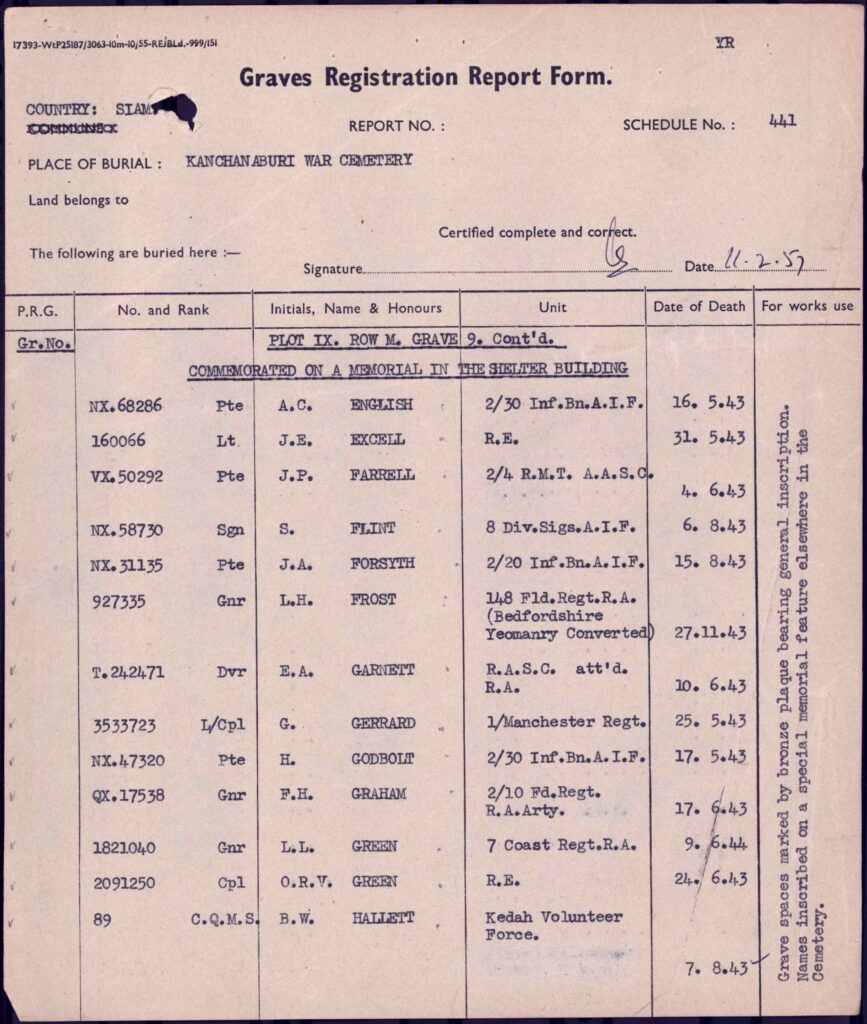
What makes Gunner Green unique is not how he died, but how history now says he died. According to the official records of the Commonwealth War Graves Commission, Green died nearly a full year later than the men whose ashes share the same grave. A simple clerical error — one misplaced keystroke — appears to have permanently altered history.
Some unknown clerk typed 1944 instead of 1943. And with that single mistake, an impossible event entered the historical record. According to official documentation, Green’s cremated remains were somehow added to a communal grave nearly one year after that grave had already been dug and filled.
That is, of course, absurd. Yet that absurdity remains preserved in the official record to this day. How many researchers have since consulted that date and accepted it unquestioningly? How many secondary sources have unknowingly perpetuated the mistake? The citation trail leads back to the original record card, where someone in 1957 initialed approval of the data.
One moment of clerical inattention. One wrong key struck on a typewriter. And the error now echoes forward through time.
I have been in communication with the CWGC office in Canada, which oversees Asian cemeteries including Kanchanaburi War Cemetery, historically known as Don Rak. The response was enlightening.
Correcting these records is apparently no simple administrative matter. One gets the impression that altering even a misplaced period requires the personal intervention of the King himself.
In short: It is never going to be corrected. The error remains. History adapts. Live with it.
But this is not an isolated case.
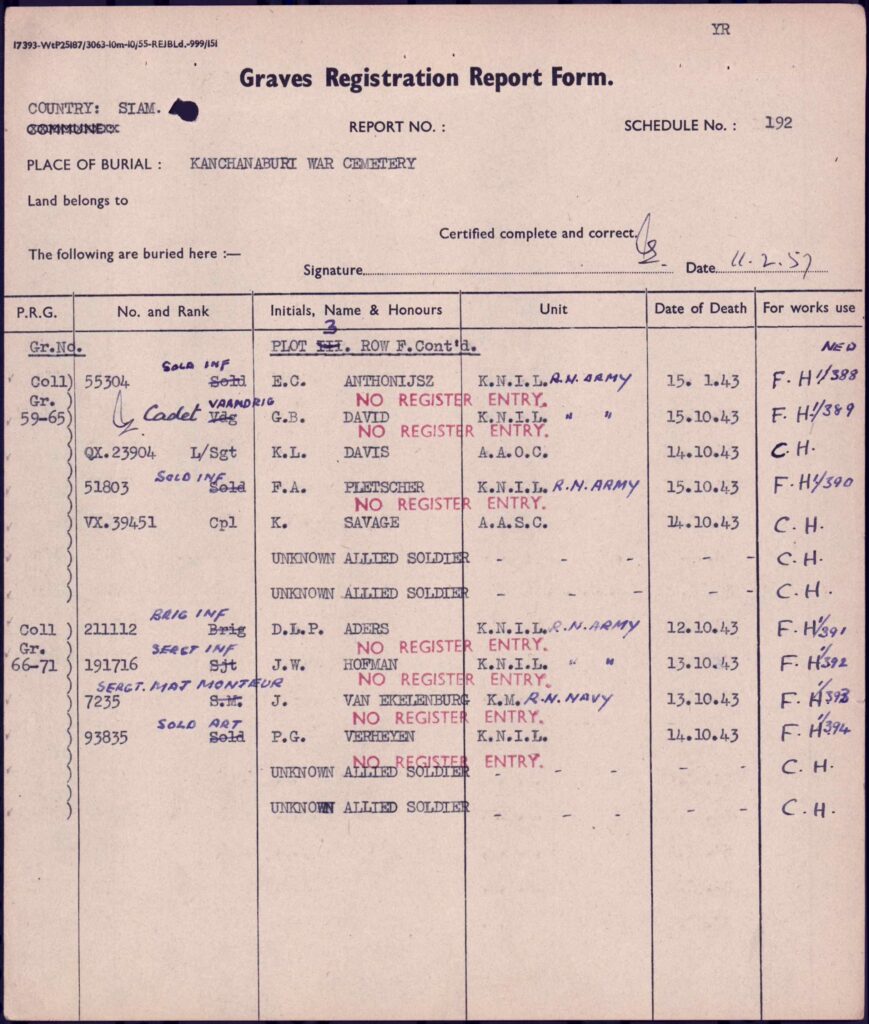
Consider Dutch soldier E. D. Anthonijsz. The official CWGC database records Anthonijsz as dying at Kui Yae camp (Km 186) in January 1943. Immediately a problem emerges. The next recorded death at Kui Yae is not listed until May 1943. January seems implausibly early for a death at a camp so far advanced along the railway construction timeline.
So I revisited the original CWGC record card. Anthonijsz appears as the top entry. Every other individual listed on that same card died in October. An obvious question arises. Was the original clerk simply missing a zero? Could JAN – denoted as month 1– in the official record actually have been intended as OCT – denoted as month 10?
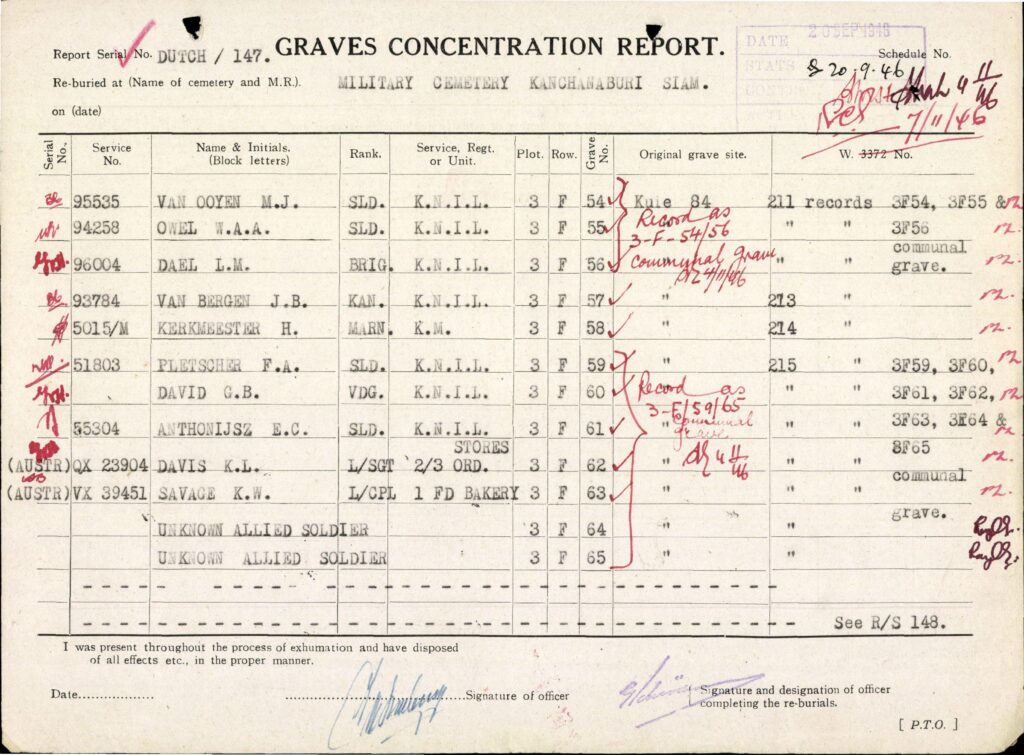
A second associated CWGC exhumation card raises even more questions. Anthonijsz is shown as having been recovered from a communal grave. Yet all others buried in that grave died many months later. Are we really expected to believe his remains sat alone in that burial site for nine months before the others joined him?
Far more likely: Another simple transcription error entered the record decades ago. And once entered…It became history.
These examples reveal something historians often forget. Official records are not infallible. Archives are not sacred. Even the most respected institutions inherit errors created by tired clerks, poor handwriting, damaged records, or simple human oversight. And once these mistakes enter official databases, they become astonishingly difficult to remove.
What begins as a typo becomes accepted truth. Repeated. Cited. Published. Perpetuated. Until eventually nobody questions it.
The lesson is simple. Never assume an archive tells you what happened. Sometimes it merely tells you what someone typed.And history, unfortunately, has a very long memory.