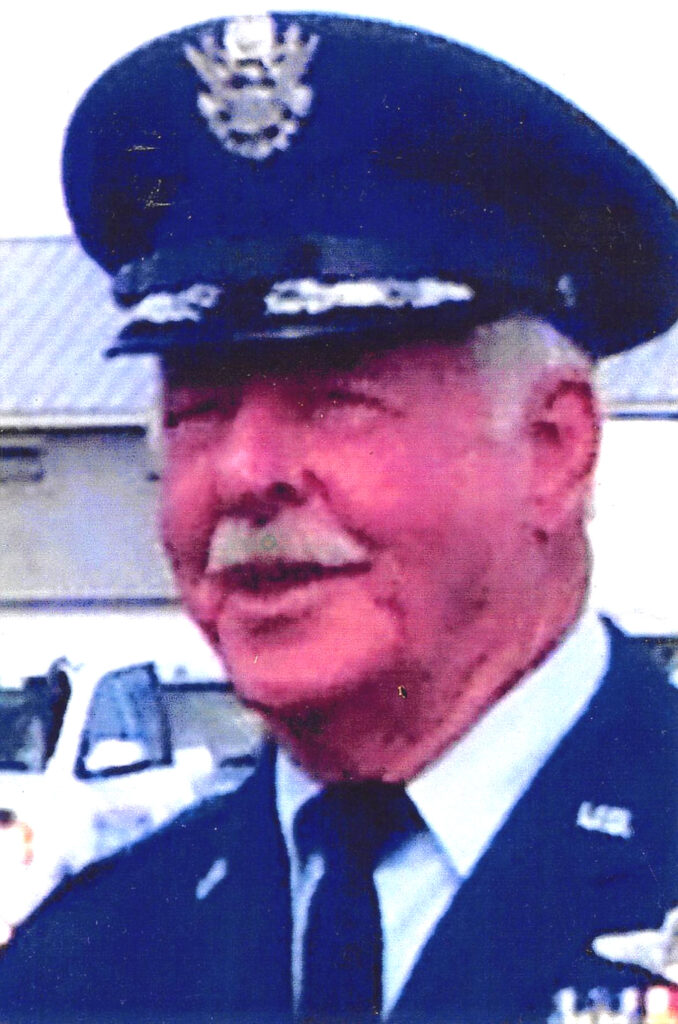
COL Thomas Sledge
In 1994, Kyle Thompson published his POW survival story entitled: A Thousand Cups of Rice = shorthand for the 3 and half years that the Lost Battalion men spent as POWs. In it, he describes the ‘near miss’ that the Tharp Party had when en route to Burma from Singapore, the ship the Dai Moji Maru was attacked by a flight of B-24s.
A few years later, Arthur Clark, a combat mate of Thompson’s was contacted by a retired USAF Colonel, Thomas Sledge. He claimed to have been one of the B-24 crewmen on that fateful day. He attended a Lost Battalion reunion and met the men that he almost killed.
MOJI MARU
While en route from Singapore to Burma, the US and Dutch POWs were part of a three-ship convoy. The convoy came under a bombing attack by US B-24s, probably flying out of India or Ceylon. One of the transports (Nichimei Maru) carrying many Dutch Prisoners and the accompanying gunboat were sunk (no Americans were on that transport). The ship carrying the US POWs (Moji Maru) was hit in the stern and damaged but continued on to Burma. By the time they approached the port, the ship was listing badly so the guards herded the prisoners to one side of the ship in an effort to correct the list.

A number of POWs have described the ‘near miss’ that took place in JAN 43 as the main US group was sailing from Singapore to Burma. They were in a three ship convoy consisting of a small gunboat (apparently a converted civilian vessel) and two Hellships: the Nichimei Maru and Moji Maru.
About a day’s sailing out of Moulmein, they were spotted by a flight of three US B-24s. Each plane in turn banked over and made a bombing run. The first hit the gunboat which disintegrated on impact. The stick of bombs from the second fell directly into the forward hold of the Nichimei Maru. The ship broke in half and the forward section sank quickly. This had been occupied by IJA Railway Engineers and is thought to have contained a looted Steam Engine from Malaya. The aft section was occupied by Dutch POWs. Most of them were able to get into the water, some with life jackets.
The Moji Maru was carrying the Tharp group of US and other Australian POWs. The bombs from the third plane straddled the ship showering it with shrapnel. A few of the AUS POWs were killed and others severely wounded, but the ship was not heavily damaged. Drawn by the commotion of the first two attacks, the POWs stood on the deck watching in horror as that third plane made its bomb run.
They go on to describe something of a comedy of errors that likely saved their lives. The Moji Maru had two field artillery pieces chained to the deck; one forward and one aft. The B-24 must have approached bow to stern. The Japanese fired the forward cannon as the plane approached then swung it around for a second shot. This one hit the ship’s bridge starting a fire. When the aft cannon was fired at the departing plane, it exploded killed the crew and igniting a second fire.
Apparently out of bombs and low on fuel, the planes turned for home. The sight of the burning ship convinced them that they had hit it. The POWs assisted the crew in extinguishing the fires and the captain halted the ship to pick up survivors.
It may be mostly legend or wishful thinking, but the story is told that the Dutch POWs drowned any of the Japanese that they encountered in the water. In some versions, it was the US POWs doing the drowning, but there would not have been any US personnel in the water! Dozens of Dutch were brought aboard the Moji, including a cat mascot. Japanese records state that only about 100 of the 1500 personnel aboard were lost, but do not relate how they were rescued.
The medical staff were quite busy tending the wounded. One Australian is described as having a severe head wound that exposed part of his brain but he was walking around seemingly un-phased by that wound; until he died! US MAJ Rogers stated in a post-war correspondence that LTC Tharp received a head wound from shrapnel that bothered him for the rest of his life. His wound was serious enough that he was hospitalized upon arrival at Moulmein and joined the rest of the men some weeks later.
The deck was crowded with the newly added Dutch and bomb damage had caused the ship to list. The POWs were said to have been herded to one side to help correct that list! The ship limped into Moulmein the next day and the AUS POWs were buried there. Others were sent to the town hospital.
[See the account in Section 3.4.6 of USAF COL Sledge contacting the men that he nearly killed.]
In his North Texas Univ Oral History interview (OH-486), Army medic Ray Reed makes the interesting statement that in the confusion of the aftermath of the bombing a few of the sailors were discussing trying to seize the ship and sail west towards India. Of course, they had no idea if there was sufficient fuel for such a journey. This ‘plan’ was scuttled when a Dutch officer told the ship’s captain who immediately armed his crew.