
The Burma Sector
In most histories of the Thai–Burma Railway construction, the Burma sector receives far less detailed attention than the better documented camps and work parties in Thailand. This is understandable. Fewer Allied records survived, the geography was more remote, and comparatively fewer survivors left detailed accounts. Yet the available evidence suggests that construction conditions in Burma differed fundamentally from those encountered in Thailand, and these differences played an important role in determining who lived and who died.
The first major distinction was geography.
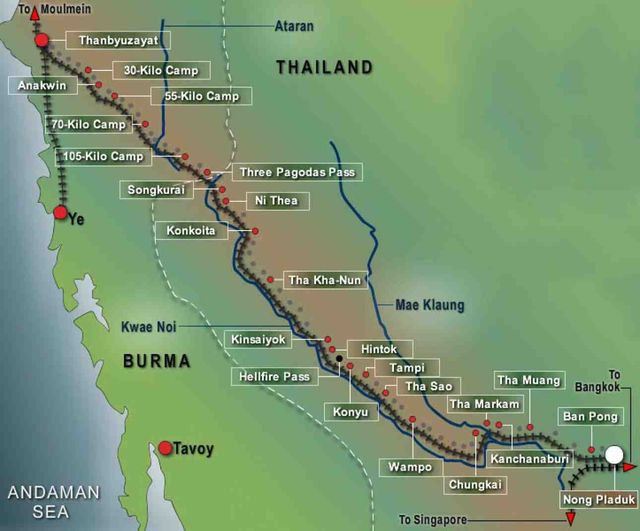
Construction in Thailand began north of Ban Pong and initially passed through relatively flat agricultural land. The route crossed terrain that had already been cultivated for generations. Existing roads, villages, and the nearby Khwae Noi river system provided a natural transportation corridor for food, supplies, and movement of materials. Although the labor was physically demanding, the environment itself presented relatively few immediate engineering obstacles.
Burma presented a completely different challenge.
Beginning at Thanbyuzayat, the first eighty kilometers were relatively flat, but unlike Thailand this terrain was covered by dense virgin jungle. Before railway construction could begin, enormous effort was required simply to clear the route. At approximately eighty kilometers near Apalon, construction entered the foothills of the Tenasserim mountain range, which forms much of the border separating Thailand and Burma.
From that point onward, the engineering challenge increased dramatically.
Unlike Thailand, where the Kwai Noi often ran closely parallel to the line of construction and could be used a supply route, the rivers in Burma generally crossed the railway route. Every crossing required bridge construction. Although the bridge over the River Kwai became the symbolic image of the railway, six of the next longest bridges on the entire railway system were built in Burma, concentrated in the final kilometers approaching the frontier. Four of these major bridges incorporated iron structural components salvaged from dismantled railway systems elsewhere in Japanese occupied Southeast Asia.
The movement of materials created another serious complication.
While separate Japanese engineering units dismantled railway lines in Malaya to obtain rails, construction crews in Burma often worked ahead building embankments and preparing the roadbed while waiting for shipments of track to arrive. Once rails became available, work parties were ordered backward to begin laying track over previously completed sections. When the rails ran out, labor shifted forward again to resume earthworks. Construction was not a steady forward progression but a repeated cycle of advance, retreat, and advance again.
This distinction becomes particularly visible when examining the experience of American prisoners of war.
The American contingent on the railway was not a single homogeneous work force. In Burma, two separate American groups experienced entirely different conditions.
The first group, consisting of approximately two hundred men under Captain Fitzsimmons, arrived in Burma in November 1942. They were stationed near Thanbyuzayat at a developing rail yard that served as a major logistical center for materials moving toward the advancing construction front. For much of their early time in Burma, the Fitzsimmons group performed relatively little direct railway construction. Their primary labor involved unloading and loading rail cars, shifting supplies, and forwarding construction materials north as work progressed.
As a result, mortality within this group remained relatively low during the early construction period.
The second and much larger American contingent, led by LTC Blucher Tharp, arrived in January 1943. After only a short period near Thanbyuzayat in the 18 to 20 kilometer sector, the Tharp group was pushed forward to Apalon (Kilo 80) and spent the vast majority of its railway labor in the final twenty kilometers approaching the Thai border.
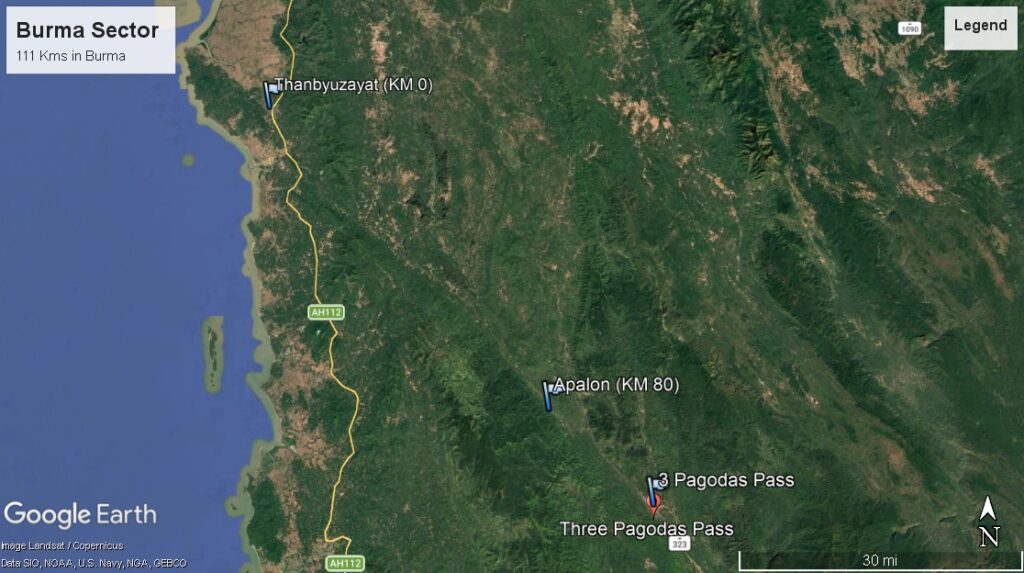
This was the most difficult section of the Burma railway.
Here construction entered the foothills of the mountains. Bridge building dominated the engineering effort. Supply shortages were frequent. Labor forces repeatedly shifted backward and forward as materials arrived unpredictably. The physical demands imposed on the men were substantially greater than those experienced by the Fitzsimmons group working further to the rear.
The difference in mortality was striking.
The Tharp contingent suffered the overwhelming majority of American deaths in Burma. By contrast, the Fitzsimmons group remained relatively spared until very late in the construction period. Only when they were eventually leapfrogged forward toward the border region and began performing direct construction work did deaths begin to occur with increasing frequency.
Timing also played an important role. When the Fitzsimmons group finally crossed into Thailand, they entered work areas that had recently been devastated by cholera outbreaks. Fortunately for them, the epidemic had subsided by the time of their arrival. Had their movement occurred only weeks earlier, their mortality experience may have been very different.
The lesson is clear. Historical accounts often describe prisoners on the railway as though they shared a common experience. They did not.
Even within a single national contingent, labor assignment determined survival. The Fitzsimmons group largely performed logistical support work in rear areas and initially suffered relatively few losses. The Tharp group was placed directly into the most physically demanding section of the Burma sector and paid heavily for it.
The railway was not a uniform system. Not all prisoners performed the same work. Not all sectors imposed the same physical burden. And not all men faced the same probability of survival. To understand why men died on the Thai–Burma Railway, it is not enough to know who they were. One must also know exactly where they worked. And nowhere was that reality more evident than in Burma.