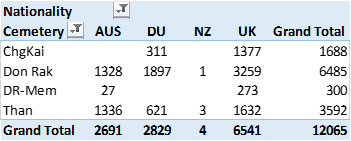
I started my quest to honor the men who gave their lives as a result of their time working the Thai-Burma Railway by downloading the available records from the CWGC website. This provided me with a base of just over 12,000 deaths[1].
But then I began to understand that there were many more deaths. These were only the men who had died in either Thailand or Burma and not all of them had actually worked the Railway. Some (62) had died before their work party reached the Railway camps. Surely there were others who also died elsewhere. What about the men of F & H Forces who must have died soon after their return to Singapore? What about the men who were lost at sea when their Hellships were sunk on the way to Japan after they had worked the TBR? Then, of course, there were the 133 US POWs whose remains were repatriated to the USA.
Then I discovered that the keepers of the Commonwealth data sets only included the Dutch POWs who were laid to rest in the cemeteries that they manage and maintain. The list of men and the many places where they were commemorated – either by actual burials or plaques of remembrance for those whose remains were not recovered – began to grow.
Over 2200 men were lost at sea en route to Japan. They are memorialized in a number of places; most at the Singapore Memorial, but also in Malaysia (500 AUS) and Indonesia (225 Dutch).
In addition to that latter group, the Dutch erected a plaque at the Don Rak cemetery to commemorate 72 men whose remains were never recovered. But there are existing Dutch data sets that document 203 more not so named. [See below in blue hi-lite]
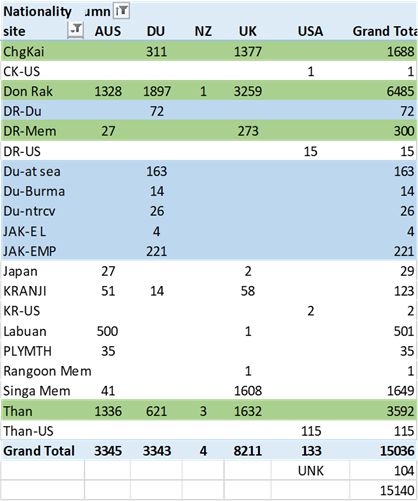
For an unexplained reason, 35 Australians who were lost at sea are memorialized in Plymouth, England. Twenty-nine TBR-veterans are buried in Japan and 123 at the Kranji cemetery. Most of these are F & H members who died post-TBR. I even located one lone British TBR-vet memorialized in Rangoon.
All tallied, I found (so far) 15036 named individuals. That left those whose names were not documented. Unfortunately, the base set of data from the CWGC does not include these Unknown Soldiers. Yet, there are indeed graves at the three CWGC sites so labelled. The question was how many. For this information I turned to the Find-a-Grave website. There within the 3 sites I identified 104 Unknown graves.
But when properly sorted, we can glean quite a bit of information by examining these graves in the context of their nearby companions. We know that the remains of the POWs were re-buried at the CWGC sites in batches as they arrived from their original places of interment in the jungles. Also, many of these UNK graves are ‘collective’ graves; men who died together, were buried together (often after cremation). So we can infer that they all died at the same time and place. In rare instances we can even infer their cause of death. If 1 unknown was buried with 5 compatriots all of whom are known to have died of cholera, we can infer that that UNK SOLDIER more than likely also died of cholera and they are in a ‘collective’ grave because they were cremated together.
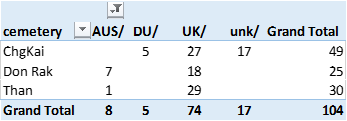
There is another special circumstance at the Burma cemetery that assists in identifying nationality. There were only a few hundred (approximately 400) British POWs who worked in the Burma Sector. And yet there are over 1600 known British graves there. This is because of the special ‘hospital’ camp that was established at Thambaya (KILO 50) for men of F Force. When the plot numbers of the known and unknown remains are examined, 29 of the 30[2] UNK graves at that cemetery are aligned with those coming from that hospital and nearly all men there were British. So with reasonable certainty we can assign a nationality to all but 17 of the 104 UNK SOLDIERs. The graves at ChungKai[3] are too mixed between UK and Dutch POWs to make any reasonable inferences in many cases.
So to date, there are 15140 known TBR-related deaths. Are there more? Possibly. The CWGC records for burials at the Kranji cemetery make no reference to the man’s status as a TBR-veteran. Likewise, there are possibly men memorialized in the Columns there who have a TBR link that I have yet to identify. The odd (unexplained) citations of known TBR-veterans in places like Rangoon or Plymouth leave open the possibility that other such citations have yet to be discovered.
[1] The 300 showed as DR-Mem are the men in the two common graves who are named in the kiosk on site at Don Rak. The other graves have individual headstones even if it is uncertain precisely whose remains are beneath them as in the case of the ‘collective’ and ‘joint’ graves.
[2] The remaining Unknown grave is actually labelled as an Australian Soldier.
[3] We also know that there are no AUS graves at ChungKai. For unexplained reasons, all who were originally buried there were moved to Don Rak.