FEB 2025 UPDATE:
I started my quest to honor the men who gave their lives as a result of their time working the Thai-Burma Railway by downloading the available records from the CWGC website. This provided me with a base of just over 12,000 deaths[1].
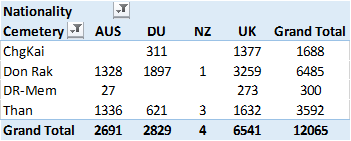
But then I began to understand that there were many more deaths. These were only the men who had died in either Thailand or Burma and not all of them had actually worked the Railway. Some (62) had died before their work party reached the Railway camps. Surely there were others who also died elsewhere. What about the men of F & H Forces who must have died soon after their return to Singapore? What about the men who were lost at sea when their Hellships were sunk on the way to Japan after they had worked the TBR? Then, of course, there were the 133 US POWs whose remains were repatriated to the USA.
Then I discovered that the keepers of the Commonwealth data sets only included the Dutch POWs who were laid to rest in the cemeteries that they manage and maintain. The list of men and the many places where they were commemorated – either by actual burials or plaques of remembrance for those whose remains were not recovered – began to grow.
Over 2200 men were lost at sea en route to Japan. They are memorialized in a number of places; most at the Singapore Memorial, but also in Malaysia (500 AUS) and Indonesia (225 Dutch).
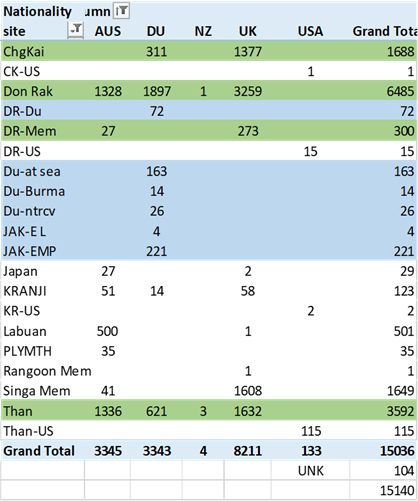
In addition to that latter group, the Dutch erected a plaque at the Don Rak cemetery to commemorate 72 men whose remains were never recovered. But there are existing Dutch data sets that document 203 more not so named. [See below in blue hi-lite]
For an unexplained reason, 35 Australians who were lost at sea are memorialized in Plymouth, England. Twenty-nine TBR-veterans are buried in Japan and 123 at the Kranji cemetery. Most of these are F & H members who died post-TBR. I even located one lone British TBR-vet memorialized in Rangoon.
All tallied, I found (so far) 15036 named individuals. That left those whose names were not documented. Unfortunately, the base set of data from the CWGC does not include these Unknown Soldiers. Yet, there are indeed graves at the three CWGC sites so labelled. The question was how many. For this information I turned to the Find-a-Grave website. There within the 3 sites I identified 104 Unknown graves.
But when properly sorted, we can glean quite a bit of information by examining these graves in the context of their nearby companions. We know that the remains of the POWs were re-buried at the CWGC sites in batches as they arrived from their original places of interment in the jungles. Also, many of these UNK graves are ‘collective’ graves; men who died together, were buried together (often after cremation). So we can infer that they all died at the same time and place. In rare instances we can even infer their cause of death. If 1 unknown was buried with 5 compatriots all of whom are known to have died of cholera, we can infer that that UNK SOLDIER more than likely also died of cholera and they are in a ‘collective’ grave because they were cremated together.
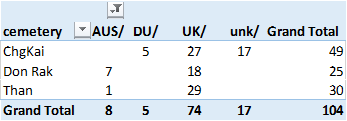
There is another special circumstance at the Burma cemetery that assists in identifying nationality. There were only a few hundred (approximately 400) British POWs who worked in the Burma Sector. And yet there are over 1600 known British graves there. This is because of the special ‘hospital’ camp that was established at Thambaya (KILO 50) for men of F Force. When the plot numbers of the known and unknown remains are examined, 29 of the 30[2] UNK graves at that cemetery are aligned with those coming from that hospital and nearly all men there were British. So with reasonable certainty we can assign a nationality to all but 17 of the 104 UNK SOLDIERs. The graves at ChungKai[3] are too mixed between UK and Dutch POWs to make any reasonable inferences in many cases.
So to date, there are 15140 known TBR-related deaths. Are there more? Possibly. The CWGC records for burials at the Kranji cemetery make no reference to the man’s status as a TBR-veteran. Likewise, there are possibly men memorialized in the Columns there who have a TBR link that I have yet to identify. The odd (unexplained) citations of known TBR-veterans in places like Rangoon or Plymouth leave open the possibility that other such citations have yet to be discovered.
I’ll close with an observation. Rod Beattie in his 2015 ’Green Book’ lists deaths by nationality and time period. I was able to sort my data set to match his time-frame and came up with slightly different numbers. I have included my ‘assigned’ nationality for the Unknowns in my count.
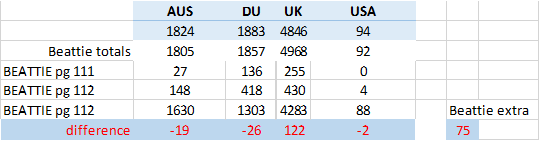
He has significantly more British deaths and fewer of each of the other nationalities. It is unclear how such a disparity would arise, unless he is using dates of death that differ from those used by the CWGC.
The generally accepted number of Allied POWs who worked the TBR is between 60 and 61,000; 15140 deaths place the raw death toll at 25%.
[1] The 300 showed as DR-Mem are the men in the two common graves who are named in the kiosk on site at Don Rak. The other graves have individual headstones even if it is uncertain precisely whose remains are beneath them as in the case of the ‘collective’ and ‘joint’ graves.
[2] The remaining Unknown grave is actually labelled as an Australian Soldier.
[3] We also know that there are no AUS graves at ChungKai. For unexplained reasons, all who were originally buried there were moved to Don Rak.
================================
In the aftermath of World War II, a dedicated team embarked on a mission to locate and identify the graves of Allied prisoners of war (POWs) who perished during the construction of the Burma-Thailand Railway. This effort was crucial in ensuring that the fallen received proper recognition and that their families were informed of their final resting places.
The Mission
In September 1945, a multinational War Graves Registration unit (26th AGU) commenced an initial reconnaissance of the Burma-Thailand Railway. Their objective was to identify approximately 10,500 burial sites of Allied military personnel who had died during the railway’s construction. The team meticulously traversed the railway from Nong Pladuk in Thailand to Thanbyuzayat in Burma, locating POW cemeteries and recovering documents and films that had been secretly buried in individual graves by senior POW officers for post-war retrieval.
Key Individuals
- Lieutenant Jack Holder Leemon (1910–1962): An officer in the 26th Australian War Graves Unit, Lt. Leemon played a pivotal role in the survey party. He provided detailed accounts of the unit’s methods in identifying and exhuming bodies, as well as the reburial processes during the September 1945 mission to survey grave locations along the Burma-Thailand Railway.
“The Body Snatchers” typescript account of Leemon’s service with 26th War Graves in Burma and Thailand. He provides a detailed account of the role of the unit and the methods they used to identify bodies, the exhumation process, and reburial; mentions the role of the local people in location of cemeteries and graves, the role of the ANGAU controllers and the surrendered Japanese.
It is detailed and well written providing a good account of post war Singapore, Bangkok (including the behaviour of liberated prisoners of war), Rangoon and the September 1945 trip to survey the grave locations along the Burma Thailand Railway including Thanbyuzayat and Kanchanaburi, with Padre Babb, Jack Sherman and others. He also mentions the role of conscripted coolie labour and their death rate.
- Reverend Henry Cecil F. Babb: A British ex-POW and chaplain in the East Surrey Regiment, Reverend Babb was attached to the War Graves Registration unit during this mission. Having been imprisoned in various camps in Thailand, his firsthand experiences were invaluable. He maintained a detailed diary from September 22 to October 10, 1945, chronicling the team’s journey, the methods employed to locate graves, and the challenges faced, including attacks by marauding groups and interactions with Japanese personnel assisting in the search. iwm.org.uk
IWM doc: 3DRL/6012(A)
BABB’S DIARY RECORDING JOURNEY BY BABB AND OTHER EX PRISONERS OF WAR OF JAPANESE ALONG BURMA SIAM RAILWAY LINE FROM BANGKOK TO THANBYUZAYAT TO POINT OUT LOCATION OF GRAVE SITES TO WAR GRAVES COMMISSION PARTY. SEPTEMBER TO OCTOBER 1945.
Albert Eldridge: Co-author with Babb’s of: First reconnaissance of the Burma-Siam Railway
Challenges and Achievements
The mission was fraught with difficulties. The dense jungles, deteriorated infrastructure, and the sheer scale of the task posed significant challenges. Despite these obstacles, the team successfully located the majority of the graves they sought, ensuring that the sacrifices of these soldiers were honored and remembered.
Rod Beattie writes in his 2015 edition of The Death Railway (the green book) that according to REV H.C.Babb, the Graves Registration Team led by Aus Lt. Jack Leemon were successful in finding all but 52 graves for which they had location information.
This seems like a very specific number. I’m attempting to run down more information of this claim.
=================
Ten Australian POWs belonging to A Force were executed for an attempted escape attempt in Tavoy soon after their arrival from Singapore in JUN 42
Once again, I queried CHATGPT:
Were ten POWs executed by the Japanese in Burma in JUN 1942?
Yes, ten Australian prisoners of war (POWs) from the 4th Anti-Tank Regiment, Royal Australian Artillery were executed by the Japanese at Tavoy, Burma, in June 1942.
Summary of Events:
- These men were originally captured after the fall of Singapore in February 1942.
- They were sent to Burma as part of “A Force,” a group of Australian POWs forced to work on construction projects, including an airfield at Tavoy.
- They attempted to escape but were recaptured.
- In June 1942, the Japanese executed all ten men without trial as punishment and as a warning to others.
List of the Executed POWs:
- Warrant Officer Class II VX45344 Matthew Wallace Quittenton
- Sergeant VX31946 Clifford Edmond Danaher M.I.D.
- Bombardier VX57043 Allan William Glover
- Lance Bombardier VX38444 Aubrey Alfred Emmett
- Lance Bombardier VX46835 Arthur Henry Jones
- Gunner VX27292 Arthur Reeve
- Gunner VX47903 James Alexander Thomas Wilson
- Gunner VX24316 William Vern Austin
- Gunner VX31670 Thomas Stephen Cumming
- Bombardier VX41901 Oswald Kennith Osborn
In that same month, two other POWs recently arrived with the work group known as 5A at the 40 KILO camp near Betetaung, Burma and belonging to the 2/29th Battalion of the Royal Australian Infantry: Private VX50944 EARNEST JAMES BELL and Private QX20799 ARTHUR FRANCIS DAVEY were also executed after an escape attempt. These were the first such acts that took place during the construction of the Thai-Burma Railway.
======================
YOU DECIDE
Once again, on page 118 of his “Green Book” Rod Beattie presents two sets of figures by nationality: estimate of the number of POWs and estimate of the percentage of deaths.
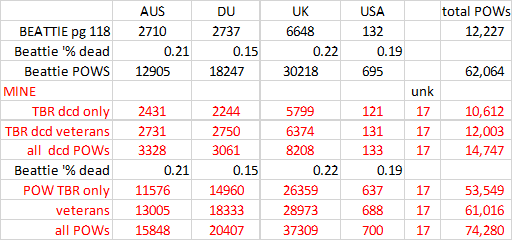
Using those figures we can calculate the total estimate of POWs by nationality. This tallies to a total of 62,064 TBR –related POWs in Beattie’s world.
My data is coded somewhat differently. There is no way to know what time period or level of participation Beattie used for his estimate of deaths. I can present three sets of estimates depending on who is counted.
In the first line tallying to 10,612, I have used the deaths I have accumulated as occurring solely during the construction period.
The second line (12,003) includes all the TBR-veterans regardless of when/where they died in Thailand. Lastly, I’ve counted all the POW deaths including those who died after leaving Thailand but not those (393) who died prior to working the TBR (14,747)[1].
Applying Beattie’s estimate of percentage deaths evolves estimates of the total number of POWs by nationality. Against Beattie’s 62,040, I show a range of 53, 540 to 74,280.
My middle figure 61,016 is the closest to his 62,064, differing by only 1,049. Let’s examine those two sets of figures more closely:

For whatever reasons, I show more AUS (100) and DU (87) POWs, but fewer UK. That UK figure is quite a large disparity at 1,245.
The US figure is compelling. My figure of 688 is precise and backed by a by-name listing. Beattie estimates 695. That is based on his starting figure of 132 US deaths, which in itself is a strange number to choose. 131 US POWs died in either Burma or Thailand during the TBR construction and consolidation period. Two more died elsewhere: 1 in Saigon and 1 in Singapore as TBR veterans. So, depending on exactly who you wish to count, the US death toll is either 131 or 133 by not 132! So those figures play out reasonably well. The difference of only 7 is easily explained by a simple shift in the calculation.
I have even tallied in the 17 UNK SOLDIERs whose nationality cannot be reliably determined and who are all believed to have died during the construction phase (likely during the Speedo period when the vast majority of deaths occurred).
So why the differences? Did he fail to count 100 AUS and 87 Dutch? Probably not! Those differences are easily explained in that these are calculations; a subtle change (third or fourth digit after the decimal) can explain them.
But where did Beattie come up with an additional 1245 UK POWs? Actually with the starting figure higher (6,648 UK deaths), an even smaller difference in the percent deceased would account for this seemingly larger difference. Numbers can obviously seem more out of synch that they actually are.
So, within a tiny margin of error, we end up with a general agreement that the total number of TBR POWs is between 61 and 62 thousand men.
In closing, I offer the following observation. Beattie’s figures for anything related to the TBR are probably the most oft quoted. I suppose one can say that they are ‘as good as you can get’. Yet, an oft spoken criticism is that he never explains where those figures came from. This is especially true when discussing the romusha data. But also applies to the POWs. It would certainly be more comforting to have him reveal his sources of data.
[1] The difference between 14,747 and the total number of POWs in my data base is that 393 men died before they ever arrived to work the TBR.