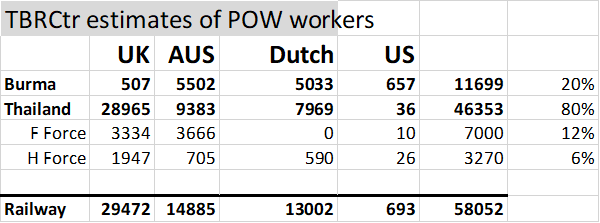
Just under 1000 US POWs were directly or indirectly involved in this saga. An additional 35 avoided becoming POWs. 689 of them worked the TBR of whom 131 died in the effort and two in the aftermath. Their 18% death toll was among the lowest of any of the Allied POW Groups.
| POW | POW | ||||||||
| ARMY | assigned | KIA | not-POW | non-tbr | TBR | dcd-TBR | dcd-else | POW lib | |
| TXNG | 546 | 3 | 34 | 149 | 363 | 63 | 24 | 425 | |
| REG | 22 | 0 | 0 | 5 | 17 | 2 | 0 | 20 | |
| AAF | 9 | 0 | 0 | 7 | 2 | 0 | 0 | 9 | |
| NAVY | |||||||||
| USN | 937 | 602 | 0 | 64 | 272 | 62 | 10 | 264 | |
| USNR | 13 | 4 | 0 | 9 | 0 | 0 | 0 | 9 | |
| USMC | 74 | 41 | 1 | 6 | 27 | 4 | 1 | 28 | |
| MerMar | 46 | 16 | 0 | 22 | 7 | 0 | 0 | 29 | |
| CIV | 3 | 0 | 0 | 2 | 1 | 0 | 0 | 3 | |
| unique | Standish | Searle | Mott | ||||||
| Total | 1650 | 666 | 35 | 264 | 689 | 131 | 35 | 782 | |
| POW | 988 | +2 | +3 | 82% | |||||
| dcd | 171 | liberated |
As the US POWs departed Java they were divided into 4 main groups. Two were destine for Burma and 2 for Japan. As each group transited through Singapore, inevitably there were a few men too sick to travel and were left behind. It was from this group and the Merchant Mariners who joined them if Singapore that the men who were sent to work in Thailand as part of F or H Force were chosen.
The chart below provides a break down the various directions that these 988 men dispersed to.
The majority (nearly 70%) ended up on the TBR; 648 worked in Burma as part of the Tharp and Fitzsimmons work groups. Only 39 spent their TBR time in Thailand. All but one of them (Flying Tiger Charles Mott) were part of either F or H Force. All of these had been left behind in Singapore as their original group continued on to their final destinations. The other 30% were either not POWs (35) or were left in Java (53).
| totals | worked | Fitz | Tharp | E Batt | Zeigler | other |
| 648 | Burma | 193 | 455 | 0 | ||
| 39 | Thailand | 20 | 9 | 2 | 8 | |
| 46 | Java | 13 | 33 | |||
| 187 | Japan | 86 | 63 | 38 | ||
| 18 | Singapore | 11 | 2 | 5 | ||
| 15 | Other | 3 | 1 | 7 | 4 | |
| 35 | not POW | |||||
| 953 | POW | 196 | 487 | 117 | 65 | 88 |
The vast majority of the 2/131 soldiers were divided into 4 groups. Those in the Zeigler Grp were destine for Japan because the IJA thought that they had ‘technical’ skills that could be exploited. The Tharp and Fitzsimmons Grps were sent to Burma. E Battery had been tasked with helping to defend the vital port at Surabaya and they, too, were dispatched to Japan. Each of these four groups passed through Singapore and inevitably some men were too debilitated to continue and were left there.
The survivors of the sinking of the Merchant Marine vessel SS Sawokla off Madagascar in NOV 42 were dropped off in Singapore when the German raider Michel made a refueling stop. Seven of them ended up in H Force on the TBR. The odd-man-out in this saga is Charles Mott who was likely one of the first US POWs in this theater having been shot down in NW Thailand in Jan 42. Through a series of unlikely events, he ended up at the NongPlaDuk camp as the lone American amidst thousands of British POWs. It wasn’t until 1945 that he joined his fellow US POWs in Kanchanaburi.
In all, 171 of the 988 (17%) died during the war, including 8 who were never taken as POWs. 133 men died as a result of their TBR experience; 131 while on the TBR and 1 each in Saigon and Singapore following completion of the Railway. The second largest number of deaths (19) occurred among men who were being sent from Java to Japan on the Tamahoko Maru in JUN 44.
All things considered, the 17% death rate among the US contingent was somewhat lower than that experienced by the POWs of other Allied nationalities.

Despite the fact that the Fitzsimmons Grp arrived in Burma in Nov 42 and the Tharp Grp in JAN 43, the first deaths did not occur until APR. 71% occurred during the construction phase. Only 4 deaths occur among the 37 men who toiled in Thailand[1]. The larger Tharp Grp experienced 115 of the deaths; Fitzsimmons only 13. Between JUN 44 and AUG 45, no US POWs died in Thailand. The last two deaths, NOV 44 and MAY 45 occurred in Saigon[2] and Singapore1 respectively.
Overall, 75% of the Allied POWs died of infectious causes. For the US contingent this was almost 79%. But no US POW died of cholera nor any from an injury. And unlike the larger POW group, Tropical Ulcers resulted in more deaths (53)[3] than dysentery (44) or malaria (7). All but 2 of the dietary deaths were due to Beri-beri. Only 1 man was KIA in a bombing in Burma. Thirty-three of the Burma veterans were sent to Japan, none perished en route or in country.
[1] A fifth death was the final US POW to die in Singapore in May 45 of a brain tumor. He had originally been a member of E Battery and worked in H Force.
[2] Originally a member of the Tharp Grp in Burma.
[3] Plus 1 from TB.
==================================
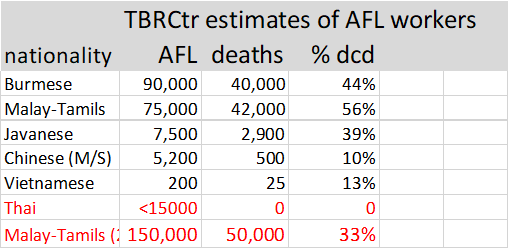
The following 2 charts pertain to the TBR as a whole. They are provided by the Thai-Burma Railway Centre and are perhaps the most oft quoted figures. I present them here for completeness and comparison.