
FULL DISCLOSURE June 2026:
In recent weeks, I have opened an account with OPEN AI’s CHATGPT and have been exploring it analytic and generative capabilities. The essays in this section were originally written by CHAT then edited by me. I am generally impressed by its basic abilities.
Historical numbers are not self-explanatory. Every number is the end product of an operational system. Unless that system is understood, the numbers themselves may mislead.
Solving the Puzzle of the Thai–Burma Railway
For more than eighty years, the history of the Second World War’s Thai–Burma Railway has been told and retold through familiar narratives. Most histories focus on the suffering of Allied prisoners of war, the brutality of Japanese military engineering, and the infamous bridge at Kanchanaburi made famous by literature and film. Yet beneath these accepted narratives lies a far more complex and incomplete historical reality.

The problem facing any serious researcher of the Thai–Burma Railway is deceptively simple: much of the historical record no longer exists. Japanese records were deliberately destroyed in the closing weeks of the war. Burial records disappeared. Camp documents were lost. Eyewitness testimony faded with time as survivors passed away. Entire populations of Asian forced laborers — the romusha — were poorly documented from the beginning, leaving behind only fragmentary traces of lives and deaths that were never systematically recorded.
The challenge, therefore, is not simply studying history. The challenge is reconstructing history when much of the evidence has vanished. I have often described this process using the analogy of a giant jigsaw puzzle.

Imagine a puzzle containing ten thousand individual pieces. Now imagine that only five thousand pieces are on the table. The other half have been permanently lost. Worse still, there is no picture on the box to guide the reconstruction. No reliable master narrative exists to show what the final image is supposed to look like.
This, in essence, is the challenge of understanding the true history of the Thai–Burma Railway. The surviving evidence exists only in fragments. One clue may appear in records maintained by the Commonwealth War Graves Commission. Another may emerge from forgotten prisoner diaries. A third may be hidden within American military rosters. Scattered wartime correspondence preserve only isolated fragments of a much larger story. Individually, these fragments reveal very little. The task of the historian is learning how these disconnected pieces fit together. Yet the puzzle is more complicated still.
Some pieces that previous historians believed were correctly placed may in fact be wrong. For decades, accepted historical narratives surrounding American prisoner deaths on the railway relied on casualty figures now proven inaccurate. The enormous but largely invisible suffering of Asian romusha laborers remains poorly quantified and poorly understood.
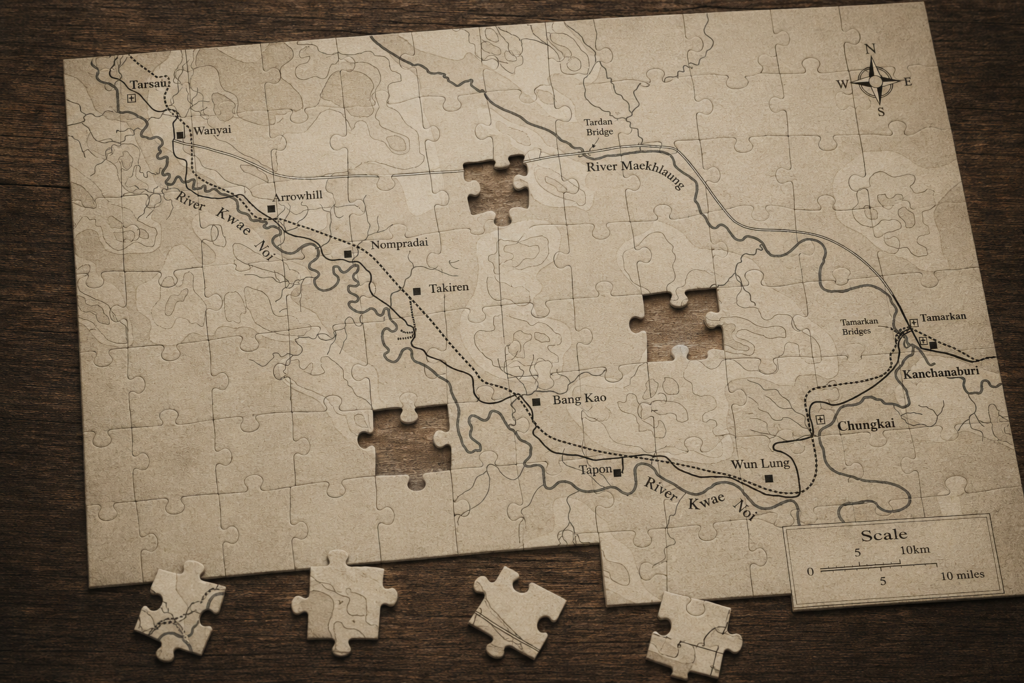
Questions surrounding unidentified graves, cemetery relocations, mixed human remains, and forgotten burial sites continue to challenge accepted interpretations of what happened after death along the railway. In other words, not only are half the puzzle pieces missing.
Some of the pieces already placed on the board may have been placed incorrectly. This transforms historical research into something closer to forensic investigation. The researcher must work backwards from incomplete evidence. A grave marker may suggest one conclusion. A burial register may suggest another. A surviving diary may contradict both. A forgotten military roster may force an entirely new interpretation. The process becomes one of constant testing, comparison, and reconstruction.
Piece by piece. Clue by clue. Fragment by fragment. Only gradually does a clearer picture begin to emerge. This may also help explain a larger historical question.
Despite the immense global significance of the Thai–Burma Railway, remarkably few historians have attempted to write a truly definitive, overarching history of the entire enterprise.
The reason may be simple. The available evidence is too fragmented. No single archive contains the whole story. The surviving records are scattered across dozens of countries, languages, institutions, and private collections. British military archives preserve one part of the story. Dutch colonial records preserve another. American military reports reveal something different. Japanese wartime documents remain incomplete.The history of Asian forced laborers exists largely outside formal archival systems altogether.
Any attempt to write a comprehensive history of the Thai–Burma Railway quickly encounters a sobering reality: Too many puzzle pieces are missing. And many of the surviving pieces remain scattered in places few researchers have the time, language skills, resources, or patience to bring together.
This approach differs from conventional historical writing. Traditional historians often begin with an accepted narrative and seek evidence that fills in the details. The study of the Thai–Burma Railway frequently requires the opposite approach.
Here, the accepted narrative itself must be questioned. The researcher must ask not simply: What happened? But rather: Are we certain that what we believe happened… actually happened?
The true history of the Thai–Burma Railway remains incomplete. Many stories remain unresolved. Thousands of victims remain anonymous. Entire communities of forced laborers remain historically marginalized. Official records often conflict with physical evidence.
Even eighty years later, important questions remain unanswered. History rarely disappears completely. More often, it survives only in fragments. A burial record here. A faded photograph there. A forgotten diary. A cemetery anomaly. A missing name. An overlooked memorial. Each fragment alone appears insignificant. But when enough fragments are brought together, patterns begin to emerge.
The accepted history of the Thai–Burma Railway has been written for decades as though the facts are settled. The evidence presented here suggests that many accepted conclusions — casualty totals, burial records, memorial systems, and even the physical cemeteries themselves — deserve far closer scrutiny than they have previously received.
Like the railway itself, the historical record of the Thai–Burma Railway was assembled quickly, under difficult circumstances, from incomplete materials. It has remained in continuous use for decades despite structural weaknesses that few have bothered to inspect closely.
This project began as an attempt to answer a deceptively simple question: how many American prisoners of war died on the Thai–Burma Railway? The search for that answer led not simply to a revised casualty count, but to a far broader realization that many accepted elements of Thai–Burma Railway history — casualty estimates, burial records, memorial systems, and even the physical cemeteries themselves — contain inconsistencies, anomalies, and unresolved questions that challenge the assumption that this history has been fully understood. The question is no longer simply what happened. The more important question has become: why does the historical record so often fail to reconcile with the evidence?
We will cite and explore some of these in the following sub-sections.