
35.09 — Missing Dutchmen
The historical record of Allied prisoners of war who died in connection with the Thai–Burma Railway is generally assumed to be both comprehensive and orderly. Following the war, bodies were recovered, graves established, and memorial systems created to ensure that the dead would be permanently remembered.
For Dutch prisoners of war, the situation is far less straightforward.
Unlike British and Australian casualties, whose records largely reside within the centralized system maintained by the Commonwealth War Graves Commission, Dutch deaths associated with the railway are distributed across multiple archival and commemorative systems. Combining records from CWGC with the Dutch national war graves organization, Oorlogsgravenstichting, and the Dutch wartime archive Netwerk Oorlogsbronnen produces a total of 3,363 Dutch military deaths connected in some way to the railway system.
Most are easily accounted for.A total of 2,850 men are buried or memorialized through conventional CWGC structures, primarily at Chungkai, Don Rak, and Thanbyuzayat cemeteries. Another 232 men are commemorated separately within Dutch military cemeteries in Java, principally at Ereveld Menteng Pulo and Ereveld Leuwigajah.
A further 72 unrecovered men are remembered on a special Dutch memorial plaque installed at Don Rak cemetery.Yet even after accounting for these categories, one final group remains.
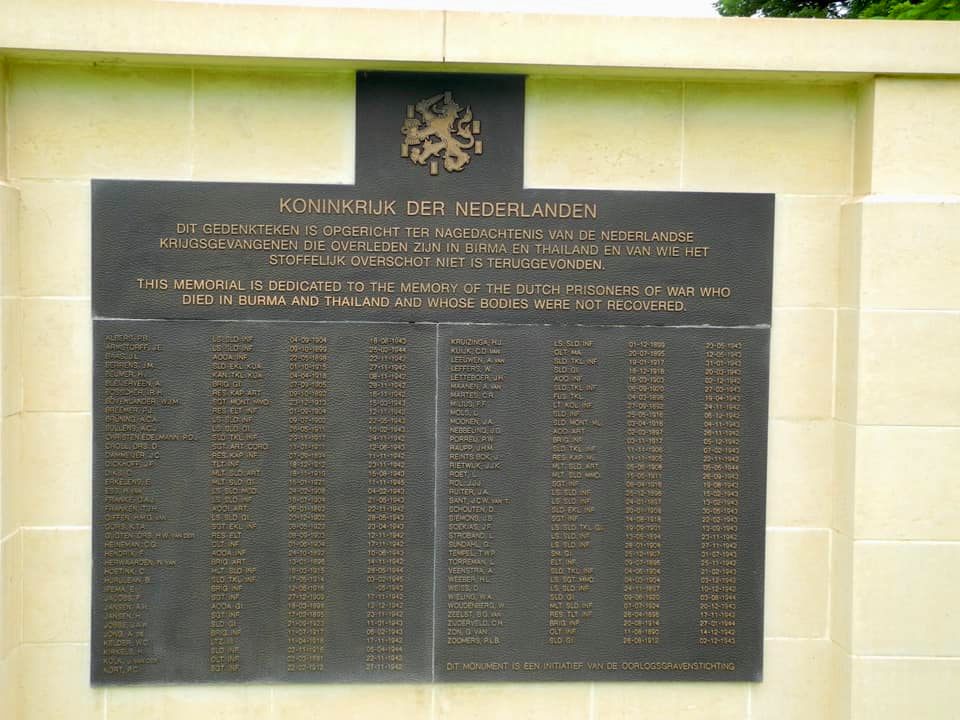
An additional 209 Dutch prisoners cannot presently be linked to any identifiable grave or memorial site. This group includes 166 men lost at sea, 27 prisoners known to have died in Rangoon, together with a small number of isolated deaths recorded in Thailand, Japan, and French Indochina.
The problem is compounded by the lack of consistency within the records themselves. Not all men commemorated on the Dutch plaque at Don Rak died while working on the railway. Some died elsewhere. Several had been transported aboard the Japanese Hellship Maebashi Maru, where severe dysentery forced the removal of critically ill prisoners in Burma. Some died in Rangoon without ever reaching the railway itself.
The categories overlap. The geography is inconsistent. No single pattern explains the final distribution. Seeking clarification, direct inquiries were made to both Oorlogsgravenstichting and the Dutch Embassy in Bangkok. Neither inquiry generated meaningful interest in resolving the status of these remaining unaccounted-for men.
The larger implication is difficult to ignore.The war cemeteries of the Thai–Burma Railway project an image of precise postwar accounting — every grave identified, every casualty recorded, every victim properly remembered. The Dutch records suggest otherwise. Even eighty years later, at least two hundred Dutch prisoners associated with this history remain suspended in an administrative void. They were counted among the dead. But somewhere between death, burial, and remembrance…they disappeared.
Addendum: The Australians Who Vanished
While examining burial records associated with Chungkai War Cemetery another unexpected anomaly emerged — one every bit as puzzling as the unresolved Dutch casualties discussed above.
Unlike the Dutch discrepancy, this anomaly concerns not men who disappeared from the historical record, but rather an entire national group whose presence appears to have been deliberately erased from one cemetery and transferred elsewhere for reasons that remain unknown.
Chungkai served as one of the principal hospital camps on the Thai–Burma Railway. Prisoners suffering from dysentery, malaria, beriberi, tropical ulcers, and general exhaustion were routinely evacuated there from work camps further up the line. Large numbers of Australian prisoners unquestionably passed through the camp and many undoubtedly died there. Logic dictates that Australian prisoners who died at Chungkai would initially have been buried in one of the two wartime cemeteries associated with the camp. Yet when the final postwar cemetery records are examined, an extraordinary fact emerges.
There are no Australian graves at Chungkai. Not a few. None.
This absence cannot be explained by geography. Australian graves remain present in large numbers at Thanbyuzayat War Cemetery in Burma, eliminating any theory that Australian authorities sought to consolidate all Australian dead into a single cemetery. Nor can the explanation lie in postwar recovery operations alone. The Allied remains recovery teams operating in Thailand were initially composed primarily of Australian personnel. The Australians themselves performed much of the difficult work locating abandoned jungle cemeteries, exhuming remains, and transporting bodies for permanent reburial. And yet, for reasons completely undocumented, Australian prisoners originally buried at Chungkai appear to have been removed and re-interred a short distance away at Kanchanaburi War Cemetery.
Why this occurred remains entirely unclear. There is no known directive from the Commonwealth War Graves Commission explaining the decision. No surviving record has yet been located documenting the rationale. No obvious logistical reason explains why bodies already buried at Chungkai would be exhumed only to be moved a few kilometers across the river to Don Rak. The decision may have been administrative. It may have been practical. It may simply have reflected an undocumented field decision made by one of the postwar search and recovery teams. The uncomfortable reality is that we may never know.
This small anomaly illustrates a larger truth that has emerged repeatedly throughout this project. The orderly cemeteries seen today create the impression that the history of the dead has been fully resolved — every body recovered, every grave properly assigned, every memorial carefully planned. The evidence suggests otherwise.
Even the cemeteries themselves conceal decisions whose logic has long since disappeared along with the men who made them. Sometimes the historical mystery is not how men died on the Thai–Burma Railway. Sometimes the mystery is what happened to them after they died.