
35.10 — History Repeated Often Enough Becomes Truth
One of the more unsettling lessons to emerge from this Section’s series of essays has little to do with the physical construction of the Thai–Burma Railway itself. Rather, it concerns the way historical understanding is created, transmitted, and eventually accepted without question.
Most readers assume that historical knowledge accumulates progressively. One researcher uncovers evidence, another refines it, later historians improve upon earlier work, and over time the historical record becomes increasingly accurate.
Unfortunately, history does not always work that way. Sometimes an estimate, an assumption, or an incomplete conclusion enters the historical record early. Later writers repeat the information, often without revisiting the original evidence. The repeated statement gradually acquires authority simply because it has been repeated so often.
Over time, uncertainty quietly transforms into accepted fact. The history of the Thai–Burma Railway offers numerous examples.
For decades, casualty estimates for Allied prisoners of war have circulated in books, documentaries, museum exhibits, websites, and memorial literature with remarkably little examination of how these numbers were originally derived. In some cases, numbers first proposed decades ago continue to be cited even though the original supporting documentation remains unclear or entirely absent.
The problem extends well beyond casualty estimates. Visitors standing in front of the ordered rows at Chungkai War Cemetery might naturally assume the men buried there died there. Yet closer examination of burial records shows that many prisoners died elsewhere and were later re-interred after the war. Similarly, the complete absence of Australian graves at Chungkai creates the impression that Australians were not heavily represented there. Yet Australians unquestionably died at Chungkai Hospital and were originally buried there before being moved to Kanchanaburi War Cemetery for reasons that remain unexplained.
Dutch records reveal another puzzle. In addition to seventy-two Dutch prisoners memorialized on a special plaque at Don Rak because their remains were never recovered, more than two hundred additional Dutch prisoners remain unaccounted for in existing memorial records despite extensive searches of both Commonwealth War Graves Commission and Dutch archival databases maintained by Oorlogsgravenstichting.
Yet these unresolved discrepancies rarely appear in standard historical narratives. Why? Because once an institutional record exists, later researchers tend to trust it. Once a number appears in print, later writers repeat it. Once a memorial is constructed, visitors assume the story is complete. Repeated often enough, uncertainty hardens into truth.
The danger is not deliberate falsification. More often the problem is simple inheritance. One generation of historians accepts the work of the previous generation. Later writers cite earlier writers. The original assumptions become increasingly difficult to challenge because repetition itself begins to substitute for evidence.
This project began with a deceptively simple question concerning the accepted number of American prisoners who died on the Thai–Burma Railway. That single question gradually exposed a much larger problem. How many other accepted conclusions concerning the railway have simply been repeated for decades without anyone returning to the original records?
Perhaps the most important lesson is this. History is not necessarily wrong because people intended to deceive. History can become wrong simply because no one stopped to ask whether what everyone believes is actually true. Repeated often enough, uncertainty becomes fact.
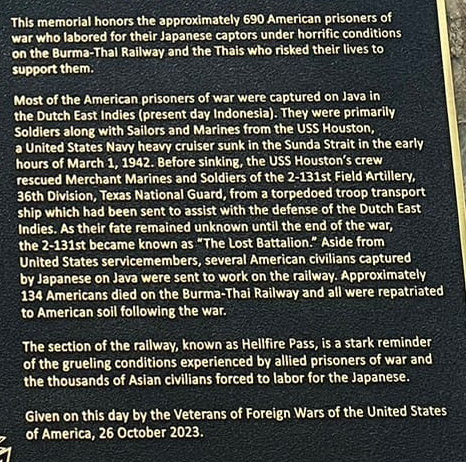
And once accepted as fact, every error acquires authority. The purpose of historical research is not simply to preserve memory. It is to continuously test whether the memory we have inherited is actually correct. The Thai–Burma Railway still contains many unanswered questions.
The uncomfortable possibility is that some of the things we think we know with greatest certainty may be the very things most in need of reexamination.