There were a total of 992 men involved in this saga. Of those, 171 (17%) did not return. There were 39 men who for various reasons were not taken captive; of those, 8 (23%) died. Of the 953 POWs, 787 were liberated.
POW POW ARMY assigned KIA not-POW non-tbr TBR dcd-TBR dcd-else POW lib TXNG 546 3 34 149 363 63 25 425 REG 22 0 0 5 17 2 0 20 AAF 9 0 0 7 2 0 0 9 NAVY USN 988 648 4 64 272 62 11 264 USNR 13 4 0 9 0 0 0 9 USMC 76 42 1 6 27 4 1 28 MerMar 46 16 0 22 7 0 0 29 CIV 3 0 0 2 1 0 0 3 unique Standish Searle Mott Total 1703 713 39 264 689 131 37 787 POW 953 all 992 3 82% dcd 171 liberated The 713 KIA include the HOUSTON crewmen who died during the FEB 42 bombing of the aft turret. A total of 689 worked the Thai-Burma Railway in some capacity; 554 (81%) were liberated while 133 died as result of that experience. The majority of the TBR POWs worked mainly in Burma; 455 with the Tharp Grp and 193 under Fitzsimmons. Another 39 were eventually attached to the F or H Forces; 20 of those were originally assigned to Tharp but were left in Singapore. Seven men from E Battery (left in Singapore) were also in the Hintok group as well as 2 from Zeigler. Seven were Merchant Mariners from the SS SAWOKLA. Then, of course, there was Charles Mott at NongPlaDuk.
Those who did not work the TBR were liberated from Japan (182), Java (22), Singapore (20) and other POW camps (14). [These figures do not exactly match those in the Table below because some died in those other locations.]
The highest death toll in any of the many sub-groups occurred among those who had been left in Java in 1942 but were later being sent to Japan when their Hellship was sunk. There were only 7 survivors with 16 killed.
totals worked Fitz Tharp E Batt Zeigler other 648 Burma 193 455 0 39 Thailand 20 9 2 8 46 Java 13 33 187 Japan 86 63 38 18 Singapore 11 2 5 15 Other 3 1 7 4 37 not POW 953 POW 196 487 117 65 88 Follow the links in the next sections to learn more about the men of the 2nd Bn 131 Field Artillery Rgt and the crew of the USS HOUSTON:
http://texasmilitaryforcesmuseum.org/lostbattalion/history.htm


http://texasmilitaryforcesmuseum.org/lostbattalion/history2.htm
Maritime Hx:
http://www.navsource.org/archives/04/030/04030.htm
Battle of Sunda Strait: per Vincent P. O’Hara
http://www.microworks.net/pacific/battles/sunda_strait.htm


In some ways, one can imagine the story of these men playing out like a Hollywood movie. There are the super-stars who stand out against the background, mentioned often for their exploits or contributions. But as in every movie there is the larger supporting cast. These men almost never get mentioned by name. But that doesn’t mean that they suffered any less or did any less. They simply fade into the background or into the jungle if you will.
Hence, I have organized the entire list of the US POWs by the various groups that they were assigned to. Except for the few unique stories, these are the Tharp and Fitzsimmons Groups that worked the TBR in Burma and the H-Force group at Hintok. [see the by-name rosters in Section 28]
There are also those whose ordeal played out in Japan or those who never left Java.
In order to properly honor them, I provide herein a list of their ranks according to which group they belonged to. It is worth restating that once under the control of the IJA, the Service of the individual meant nothing. Soldiers, Sailors and Marines were assigned to the various groups by criteria that were not always clear. Once embedded in a Group that individual was ‘locked in’. With the exception of those men who were left behind at Singapore as the various groups transited through there, each man stayed within the initial Group he was assigned to.
Following their work on the TBR, many of the Tharp and Fitzsimmons Group members were transferred to either Saigon or Japan. Others were moved to other camps like Ubon, Petchburi or on to work the Kra Isthmus Railway.
Most of the Zeigler and E Battery Groups went directly to Japan. Every group seems to have a few men who took a somewhat different path.
In Section 28, I provide lists their names and basic information by the Group that they were assigned to in order that no man be forgotten. In all 988, men suffered through this ordeal:
| ARMY | 214 |
| ARNG | 354 |
| USNV | 370 |
| USNR | 9 |
| USMC | 38 |
| AAF | 9 |
| USCiv | 3 |
| USMM | 38 |
Final status by branch:
| ARMY | ENL | NCO | SNCO | OFF | CIV |
| non-pow-lib | 25 | 1 | 1 | ||
| non-pow-dcd | 7 | ||||
| POW-DCD | 70 | 9 | 1 | 3 | |
| POW-LIB | 350 | 71 | 10 | 31 | 3 |
| USS HOUSTON | ENL | NCO | SNCO | OFF | CIV |
| non-pow-dcd | 1 | ||||
| POW-DCD | 68 | 3 | 4 | 2 | |
| POW-LIB | 222 | 39 | 7 | 22 | |
| MER MAR | |||||
| POW-LIB | 25 | 5 | 1 | 7 |
[1] The Zeigler and E Batt Grps. Others were moved to Japan and some to Saigon after the TBR work was completed.
======================
The LOST BATTALION moniker was developed by families of the nearly 600 members the Texas National Guard’s 2 Bn / 131 Field Artillery Regiment. They had been able to contact their families after reaching Java in early 1942. But suddenly all contact ceased. It was known that the Dutch had capitulated after the IJA had invaded that island, but the fate of the Americans was uncertain. At the same time, the USS HOUSTON was reported as overdue for its expected arrival in Australia. Throughout the remainder of the war, the War Department carried these men as missing in action.
The Imperial Japanese HQ had failed in their international responsibility to report that they held many of these men as POWs. This included nearly 400[1] of the HOUSTON crew and almost all of the artillerymen[2]. The vast majority were sent to work on the Thai-Burma Railway in Burma. A full accounting of these men was not determined until the end of the war. Most of the others were sent to work in Japan. The world learned of the presence of POWs on the TBR in SEP 1944 after Australian TBR veterans were rescued from a torpedoed Hellship enroute to Japan. But there was still no individual accounting of those involved.
425 of the artillerymen men, 264 sailors and 28 Marines were liberated at the end of the war. Most were TBR survivors[3]. In total, 171 of the POWs had perished; 133 of those on the TBR.
The Lost Battalion Association as a formal organization came into being around 1946–47, when survivors regrouped in Texas. These men stayed in touch, held reunions and accounted for their loses over the years. Family members were included to keep the memory of these men and their ordeal alive. Despite the horrendous conditions that they had endured, many lived into their 80s and 90s and a few became centenarians. The final man passed away in early 2024.
While the exact number is not compiled, some 50 of these men published accounts of their ordeal and nearly 100 were the subject of in-depth interviews by scholars. Even in the 2020s, family members continue to publish long hidden manuscripts of a few of these men.
It is from these accounts that we can reconstruct the events and derive a precise list of the men involved. This way we can ensure that they will never be forgotten.
[1] The HOUSTON carried a crew of just over 1000, of whom 336 sailors and 33 Marines had become POWs.
[2] Of the TXNG, 3 had been KIA and 34 evacuated leaving 512 as POWs.
[3] There were also Merchant Mariners, other Army and Navy personnel and 3 civilians who were in some way or another associated with this group.
=======================
The single book that in my opinion relates the story of the US POWs on the TBR and before, is Hell Under the Rising Sun by Kelly Crager. He uses a narrative and analytical writing style to weave the story of these men. He draws heavily on the Oral Histories gathered by Univ of North Texas Professor Marcello but his is not a series of personal vignettes but an examination of the circumstances and reasons for their plight.
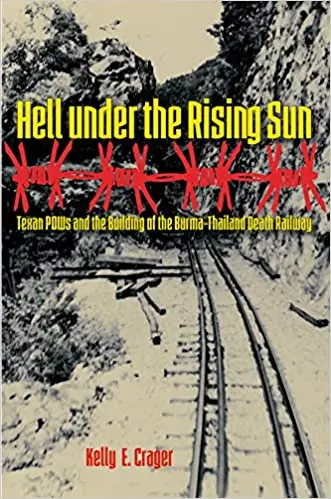
If you were to choose only one book to read on this topic, it should be this one!